Showing posts with label Japanese. Show all posts

29 March 2010

Kamanawanale'a

It's a faux Hawaiian title. Read it out loud. Hur hur. Hur hur.

And this, despite our best efforts, is probably faux Hawaiian food.

Neither of us are Hawaiian. I think Alannah's been there once. I've never even been. But back in California, we have a good number of Hawaiian friends, and one unattainable thing we really crave every once in a while is Hawaiian food.

We were walking through Paris' Chinatown the previous weekend, and like every time, were disappointed when passing by a restaurant called Hawai. Looking at the menu, it's all standard Sino-Vietnamese fare. No loco moco. No kalua pig. Not even a single taro root. In fact, it's probably pronounced "Hah-way" and our fantasies of gravy-slathered beef, pulled pork, and starch overload are just a bout of wishful thinking... At that point, we both thought, "We really need to cook up a Hawaiian feast sometime."

This last weekend we found some more off-the-beaten path ethnic stores (including a handful of tiny Filipino markets in the ritzy 16th arrondissement) and, as it turns out, wound up with what it takes to make an authentic Hawaiian meal. No, not an entire pig to roast in a sandpit under banana leaves, but that other Island staple: Spam.
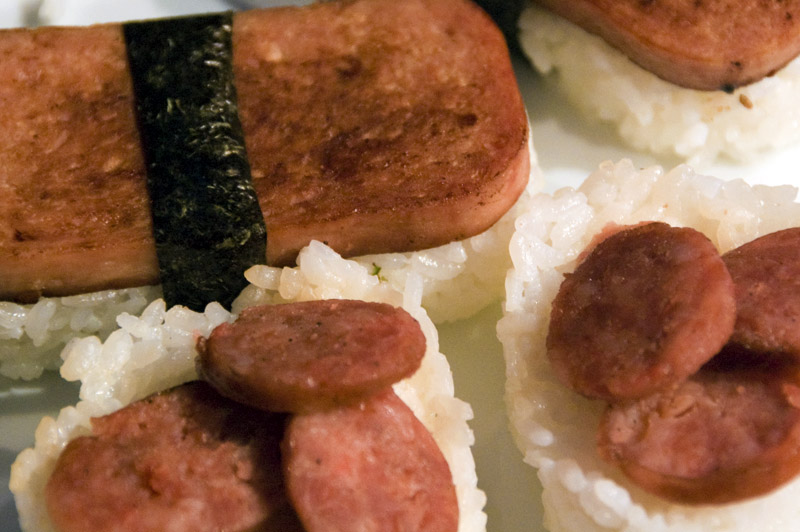
Spam musubi and Longanisa onigiri
The South Pacific has a longstanding love affair with the canned lunchmeat that's been ridiculed for decades by Johnny Carson and Monty Python. Our friend Arnold over at Inuyaki has an archive of articles on Spam. Frankly, I still find it utterly disgusting. But as soon as we saw the iconic blue can on the shelf of the Marché Manille, Alannah and I turned to each other and said in unison, "Spam musubi!"

Musubi is another term for the Japanese snack onigiri. (Many Hawaiian dishes, I've found, are derived from what I grew up with as Japanese comfort foods.) It's basically a bundle or brick of cold or room-temperature rice stuffed or topped with some sort of non-rice substance. In this case, that non-rice, non-food, non-organic substance is a fried slice of Spam. And it's magical. You can eat it warm. You can eat it cold. You can probably eat it 20 years from now.

NOTE: As conscientious foodies, we try to buy as much organic/locally produced/artisan product as possible. While it's still somewhat inexcusable, we were relieved to learn that this UK-sourced Spam is actually made under license in Denmark using European hog parts. For what it's worth, at least it's all EU.

Of course, with the guy at the Filipino store having hooked us up with some of his buddy's homemade Longanisa, we had to honor his coolness by making some onigiri with said sweet sausage as well. Not to mention it's perfectly fitting, as Filipino foods are as much a part of the Hawaiian melting pot as Japanese, Chinese and mainland. (Or so the menu at the L&L Hawaiian Barbecue chain informs me.)

Despite the setback in bequeathing it with official endangered status, the recent brouhaha over the scarcity of bluefin tuna (which is rarely served or sold in the mainstream marketplace), has seemd to make the price of all tuna go up. Despite the rather ridiculous prices, when I saw some beautiful, deeply-colored, sashimi-grade tuna at our local Sunday market, I had to pony up. All for one dish that'll get hoovered up in two seconds: Poké.

Don't worry, it's not endangered bluefin. We can't afford dat shit, brudda.
Poké is a Polynesian variant on sashimi or ceviche. You take your fresh fish, slice it up into strips or dice it into cubes, and let it marry with a blend of soy sauce, sesame oil, chilis, and sweet onion. Simple but fantastic. Like with many raw fish dishes like ceviche, it goes really well with a contrasting side like guacamole – or simply sliced avocados. But it's good enough to have straight up. I like to think of it as the steak tartare of the sea.

These cucumbers are here for the sake of not dying
of heart failure before the meal is over.
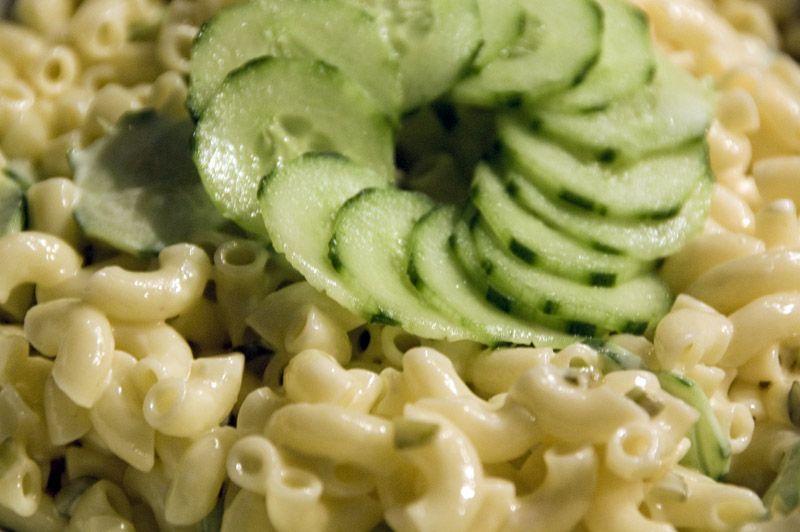
Going by experiences like the aforementioned L&L (or San Francisco's legendary Hawaiian sit-down, Da Hukilau), no platter of Hawaiian food is complete without a rich, mayonnaise-y macaroni salad. Like Spam, mayonnaise is one of those things where it takes an exception for me to like. Those exceptions are Japanese Kewpie-brand mayonnaise and the homemade stuff.

For this salad, while Kewpie would've been perfect, we simply went with making our own, which is easy: Hand-beat the ever-loving crap out of one egg yolk with a touch of vinegar, slowly adding standard salad oil (olive, peanut, etc.) until it gets to the volume and consistency you like. The approximate ratio is around 200ml (just under one cup) per egg yolk. You can use a machine, but everyone knows a good whipping by hand is where it's at.

We used less mayo than we're accustomed to from Hawaiian joints back on the Left Coast, and even lightened it up with some thinly sliced Japanese-style cucumber to give it some freshness.
Heart attack on a plate.
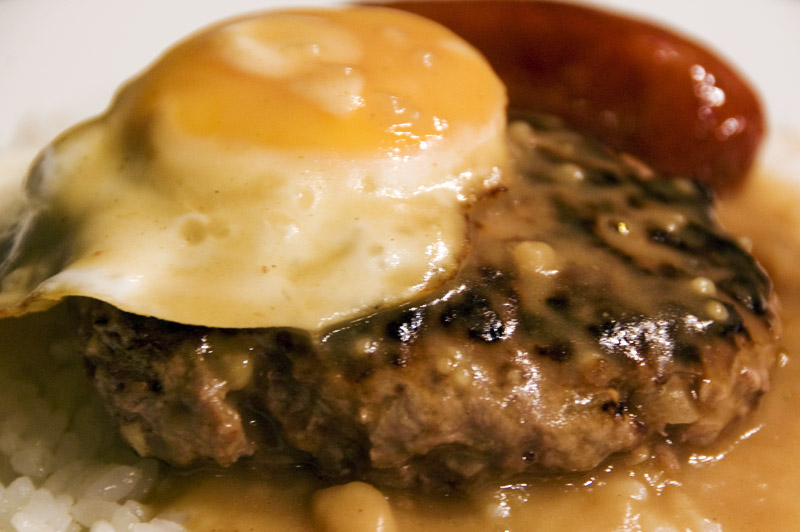
Of course, a cholesterol-heavy side dish needs an even more fat-laden main course to accompany it. And there's no Hawaiian meal easier or more satisfying to make than loco moco. Take a pile of steamed Japanese rice, top it with a hamburger patty, top that with a fried egg, and then smother it all with brown gravy. If you're insane like we are, add a link of longanisa on the side, just to seal your doom.

This was no ordinary loco moco, though. We used top grade Japanese rice made in filtered water, grade "01" eggs (the top French classification for free-range, cage-free, blah blah blah), and freshly ground steak from our local butcher (that I'd mixed with finely diced sweet onion). The result was the most amazing tasting loco moco we've ever had – largely due to the crazy hambagu steak (as they'd say in Japanese) patty. After the musubi and the onigiri and the poké and the macaroni salad, this was all just overkill.

But, well, that's what a Hawaiian feast is all about. Celebrating the abundance of starch, flesh, fat and sugar that can find its way on to an island chain in the Pacific. Or the Ile-de-France region around Paris.

That's kind of sort of an Island, right?

22 March 2010

Hot Mother-Daughter Action

After an overdose of my Iranian half of culinary heritage for Norooz, it was time to balance it all out by engaging in some Japanese debauchery. No, not anime featuring demon tentacles, uniformed school girls, and odd forms of penetration. We're simply not into that hentai stuff. But my other ethnic half's perversion doesn't end with used panty vending machines.

In fact, everyday Japanese weirdness isn't so much perversion, but an almost innocent frankness that turns out to be – like all things Japanese – very cute. Naming foods, for example, is subject to this cute-ification. Take the dish known as shirako for example. That would be fish milt. Milt is sperm. Shira is a prefix meaning white. Ko is a suffix meaning child. Sperm is white, and makes children. Hence...

Alas, there will be no eating of sperm this episode. Instead, we're talking about oyako donburi. So donburi is the common term for rice bowl (as in a bowl of rice with food on it, not unlike a teriyaki bowl). You just learned that ko means child. Oya? That means parent. Parent-child rice bowl.

Obviously, this is more of a metaphorical description of the dish. But it's not far from literal. The primary components of oyako donburi are the chicken and the egg.  We're not going to argue over who comes first. (Who cares as long as both do?)  We're going to tell you how this deliciously morbid-sounding familial dish is done.

To top each bowl of steamed Japanese rice (please don't use jasmine rice or Uncle Ben's - that only hurts me), you will need a chicken breast, 2 eggs, half a sweet onion (or three green onions), and a cup of sauce. The cup of sauce is comprised of 180 ml (1 cup) dashi (bonito stock, look it up), 2 tablespoons each of soy sauce and sugar.  Those are your ratios, and the only ingredients you actually need.

Heat up a skillet and pour in your cup of sauce.  Toss in the chicken breast, cut into thin strips manageable enough for chopsticks, not unlike a stir-fry.  Let the chicken simmer in the sauce 5-7 minutes over medium heat, then add your onions. After a few more minutes, when your onions have started to soften, pour in your slightly beaten eggs over the top of the chicken-onion-sauce concoction. Do not mix.

Scoop your hot, steaming rice into your bowls, and while the eggs are still runny (but not totally raw, eww!) use a large serving spoon to ladle it out on top of your rice. Optionally, before scooping it out, you can sprinkle it with strips of yakinori (roasted seaweed in sheet form, like what's wrapped around sushi rolls).

Serve while piping hot. The egg will continue to cook and will be ready by the time you get it to the table. For a touch of color, I added a garnish of aonori (green seaweed flakes), but some argue that over-garnishing a donburi will detract from its purity of flavor.

02 March 2010

Where's the Beef?

Until recently, if you told me to go shopping for Meatless Monday night, I'd stop by one of the dodgy shops on Rue Saint-Denis on my way from work and come home with an all-girl DVD.

We're avowed trend-haters, particularly food trends (even though Alannah's got a thing for cupcakes), but once in a while, something comes along that – while faddish – is very positive in influencing how we approach food. (Just read the link for the whole philosophy behind cutting out meat once a week so I don't have to rehash it...)

For the reason it exists, Meatless Monday is kind of moot for us.


No, we haven't gone militant vegan. Both of us are of the Anthony Bourdain school of thought that vegetarianism is an anomaly. While we're not as single-mindedly carnivorous as the chain-smoking posterboy for foodie-travel-hedonism, we're fully on board with an idea that when plucking from Mother Nature's smorgasbord, one must respect her by using everything we're given. That calf that just died? Its liver, testicles, and face are just as worthy as its meat. And speaking of its face, we're also of the firm belief that you should be able to look at what you eat in the eye, or at the very least be fully aware of where it comes from.

Considering we're very conscious about what we buy – our poultry, meat, and off-cuts come from artisan butchers and never in a styrofoam barquette – we don't particularly feel any pressure to go more "sustainable."

No, we're quite simply going Lindsey & Samantha (or is it Ellen & Portia?) this week to detox from our bacchanal of beer and beasts in England and Germany spanning the last week.

The thing about eating vegetarian (or even vegan) is that so many people try to substitute meats, and that's what turns so many omnivores off of the concept. Any sworn omnivore who's been subjected to Tofurkey or oil-based "cheese" or Soysage is likely to say "fuck that!" and become a carnivore out of spite.

Forget substituting. Forget emulating. There's such a wide array of flavors and textures and substance in the non-meat world that there's no need to try to re-create meat based dishes. After all, do you go to a southern Indian restaurant and get Textured Vegetable Protein in your dosa? No. It tastes so good, you forget you're not getting meat.

With that in mind, we put together last night's meal, that was not only colorful and healthy, but filling.

The red cabbage above may not look like much, but even on its own, it's nutty, a little spicy, and carries a lot of heft. Toss it in salt and let it sit to soften it a bit (unless you like it really crunchy), then toss it with a dressing of miso, rice vinegar, and a little vegetable oil. Hell, add peanuts if you like the whole Thai coleslaw thing. You'll love it. Instead of seeing it as a raw vegetable dish, think of it as mild Japanese fusion. Throwing some Central European flair into an Asian side dish as old as time.

The same goes for the Sesame Kale seen here.


Riffing on a classic Japanese sesame-spinach dish, wilt some curly kale, and toss in a dressing of 2 parts ground sesame seed, 1 part soy sauce, 1 part mirin, and 1.5 parts sugar. (I just divulged Alannah's kick-ass recipe. You're welcome.) Garnish lightly toasted sesame seeds. You can serve it hot, cold, or room temperature, so feel free to live out your Goldilocks cosplay fantasies with this one. You'll be ooh'ing and aah'ing like never before, satisfied with every chopstickful you lift to your lips.

One of the best parts is that it's all so easy. Even the main course we threw together is hardly more complicated than a toaster strudel...


Simmer some kombu-dashi (seaweed stock, but you can use bonito stock and we won't tell anyone) and add sugar, soy and mirin to taste. Throw whatever you want into the broth. We went with carrots, Hokkaido pumpkin (kabocha), small shiitake mushrooms and firm tofu. Before serving, I decided to add an 8-minute egg to add some more girth (and to keep from going over that vegan line of madness), but to be honest, it's a bit much.

Serve it all with a bowl of steamed Japanese rice, and you've got yourself a supple, nicely rounded meal that will leave you more satisfied than you could possibly imagine. (If you're a carnivore, that is.)

In fact, even though I don't feel the need to do Meatless Monday in terms of sustainability and reducing the flow of money to factory farmers, I'm pushing we adopt this habit simply for the widening of our palate... Or palette, so to speak.

03 December 2009

Purple Stuff: Mystery Vegetable

Please help us identify this leafy, purple vegetable.


We bought it the other day at our green grocer's, not really caring what it was, just that it looked very good. It was among the other seasonal greens (yeah, it's purple...) without any labeling. I asked the cashier what it was, and she enthusiastically told me they were... beet leaves!

This was a bit surprising to me, as I've been eating beet greens since I could remember, and they've always been green, with just a hint of red in the stem sometimes.

Before diving into them tonight, I did a little online research. The closest thing I could come up with is orach (based on this photo at The Kitchn) aka German mountain spinach. But I'm still not convinced...

We tasted some of it raw, and it actually tasted not like beet greens, but a bit like beet root! Sweet, sugary, a bit mineral-y. After lightly wilting it, though, it gave off a beet-like juice (only much less intense) and lost its sweetness, tasting more or less like spinach.

So how did we have it? I added spinach to the pan while wilting in garlic-tinged olive oil, and served it both over and under buta-no-kakuni (Japanese style braised pork belly) over chestnut basmati rice.


And yeah, it was as good as it looks.

And although Alannah wasn't as intrigued by the whole beet-like flavor (notice the beet juice coloring tinting the rice, above) I'm ready to have the rest raw in a salad, maybe with a citrusy zest.

So does anyone know what this is? And how it's normally eaten? First definitive answer wins a moist, sticky date.

No, not with Alannah, but a nice, sugary deglet noor from North Africa. (Winner must take delivery in Paris, as fruit products generally do not pass customs. Kthxbai.)

03 May 2009

Sticky Sweet: Strawberry Mochi


File under super super super super sticky, and only mildly sweet.

Despite having sworn off of making Japanese food for a while after going overboard for a week, our abundance of strawberries made me break that promise. Alannah and I both love the sticky, squishy, stuffed balls of sweet mochi known as daifuku – and above all else, we love ichigo daifuku – or strawberry mochi to the non-Japanese speaking world.

Making it isn't all that difficult. Just messy. Really sticky and messy. By the time we were done, there was white stuff flung all over the room.

It starts out simple enough: Combine even amounts of mochiko (fine rice flour) and sugar water. 100 grams of each should be about enough to make six. You can make more, but these should all be eaten the same day, or maybe the next. Keeping homemade mochi fresh - without either melting into a pile of goo or drying into a brick - is still a mystery. (Leave a comment if you have any pointers...)

Heat up the mixture over a medium burner and stir it until you have a soft dough.


At this point, this stuff will stick tenaciously to the pot, spoon, spatula, fingers, hair, clothes - anything it comes in contact with... Put the mochi dough aside and let it cool for around 15-20 minutes.

Food pr0n bordering on Scheiße...
In the meantime, hull your strawberries and wrap them with anko (red bean paste). If you're a kid – or simply immature like me – joke about how much anko sounds like unko, which is Japanese for poo.


If you look elsewhere on the web for instructions on making ichigo daifuku, you'll find that a lot of fellow amateurs simply wrap their strawberries in an even layer of anko, making it look like a vertical lump of poo. For a more professional looking end-result, after surrounding your strawberry with anko simply work the shape into a half-dome. It only takes an extra five seconds, and your daifuku won't look like... well... shit.

When your mochi dough has cooled, plop it out of the pot on to a very well rice-floured (or corn/potato starched) board. Cover your hands with flour/starch – and I mean cover – and grab chunks of the dough to quickly and gently work into golf-sized balls.

Warning: Anything that is not covered with flour/starch will stick to your balls and not let go.

In the well-starched palm of your off hand, gently flatten a ball of mochi dough, place a half-dome of strawberry/anko curved side down in the middle of the dough, and bring up the sides of the dough and pinch together. This is the bottom of your daifuku.

And that's it! Turn your ichigo daifuku over and place onto a plate - again, one dusted with flour/starch. And while you're at it, sift some more flour/starch over the completed daifuku to prevent sticky fingers.

Or in the immortal words of Samantha Fox, "Then again... that could be fun!"

01 May 2009

Japanese Clusterf***

This time I've gone too far.

While Alannah was out doing some evening volunteer work, I prepared a special surprise for her, calling in some of our favorite partners in crime for a late evening session of overindulgence: Karaage, curry and okonomiyaki.

You see, I was only half-joking in the karaage curry post about applying the combination to oknomiyaki. Not only did I pull this threesome together, but I added a fourth: Bacon.

That's right. Bacon, chicken karaage, and curry with okonomiyaki.


Don't stare like that. It's totally normal. Okonomiyaki implies "anything you want" or "however you like," after all. And those are words we often wish were literally true when uttered by someone.

Sometimes, fantasies become reality.

It started with the browning of bacon (or rather, the version more common in France, lardon), caramelizing the swine flu out of the little cubes of belly fat 'til they were rendered practically into chicharrones.

Next, I deep fried small strips of chicken marinated in ginger, garlic and soy and dredged through starch.

It was then embedded into a standard okonomiyaki batter as it cooked, with Japanese curry ladled on top, and then the customary katsuobushi, Kewpie mayo, and aonori.

Of course, getting together a pot of hot oil just to fry a few tiny strips of chicken is a bit of a waste. It can be used for so much more...

Unfortunately, wrestling in it was out of the question (too messy), so I added to Alannah's evening surprise with a big batch of karaage chicken wings.


Karaage typically calls for boneless, skinless chicken (dark meat, preferably), but wings must be handled with the fingers and are so much more fun with the bone-in. So I left the outer wings as-is, and opted to skin the drumettes. Or pilons as the French call them, which sounds decidedly less French than the English word. Go figure.

Pulling the skin off of drumettes is, like Katy Perry, a tiresome bitch hardly worth anyone's time. But in the name of proper cooking (and getting both the marinade and the starch coating to stick better) I went through with it anyway.

In the end, though, the ritualistic skinning was worthwhile. Those chunks on top are karaage popcorn chicken, made from the peeled off skin with bits of flesh attached.

In this house, not an ounce of protein goes to waste.

Sloppy Seconds: Fun With Curry

What to do with a massive amounts of leftover Omid's World Famous™ Japanese Curry? Why, have fun with it, of course!

Despite making an enormous pot of the stuff (much of which was summarily consumed on the first night), we didn't have enough to invite our favorite bikini-clad food fetishists for an evening of sploshing. Instead, we further Japanese-ified it.


Omu-rice (or omrice) is a Japanese contraction for "omelette rice," a lunch favorite often creatively slathered in ketchup, served to kids or businessmen too busy for a real lunch. (This is a very common phenomenon in Japan.) Essentially, it's rice (sometimes garnished) rolled into the middle of an omelette. To give it some real Japanese flavor, add a little bit of dashi (bonito stock) and sugar to the beaten eggs... We mixed some leftover rice with the leftover curry, heated up the mixture, and laid it inside the thing omelette exterior, all the while giving the ketchup a pass.

Simple. Pleasure.

The next incarnation of the leftovers is essentially the same thing: Curry, rice, and egg, arranging it in what could only be called the "Curry Volcano."


This time, we decided it was about time to try our hand at the onsen tamago (hot spring egg), a slowly soft-boiled egg that's just a shade on the cooked side from raw. Unfortunately, our thermometer is a damned liar, and despite reading around the 65ºC mark during the soft-boiling of the egg, it came out undercooked. Or rather, practically raw but warm, with the white becoming a slimy puddle of goo resembling... coagulated corn starch. (What did you think I was going to say?)

No matter, because the stuff all gets mixed into the hot curry and rice and cooks anyway, making a rich, satisfying dish even richer.

27 April 2009

Sensory Overload: Karaage Katsu Curry

The Japanese gang bang continued this week, as the other night we made a giant batch of Omid's World Famous™ Japanese Curry.

Now any person with kitchen competence and access to S&B (or similar) curry mix can make a decent Japanese curry. The beauty of it is that, like Lady Gaga, it's a tasty no-brainer that goes down easy. What sets mine apart? Years and years of perfection - that, and I can make a perfect base from scratch. This is actually a wholly unnecessary, time-intensive skill - even the chefs at most curry houses in Japan will use blocks of packaged curry base - but it's important if you like to cook without unpronounceable chemicals, or need to feed some vegan friends who won't eat something with traces of beef stock in it. (Last I checked, a jar of Knorr's didn't moo, hippie.)

All vitriol for air-headed pop tarts and irrational animal-worshippers aside, making your own Japanese curry base isn't that important. What is important is handling the ingredients before they're ever stewed, and then having the patience to let it all slowly simmer and reduce for hours on end. Part of my approach is to season the vegetables (and meat, of course) while it's in the sautée phase - adding garam masala, ginger, garlic, and chili while it's all browning. This ensures that all the chicken/beef/carrots/potatoes/mushrooms/whatever are nicely infused with flavor. Then there's the simmering... Not only do the hours on the stove reduce and thicken the curry, but the starches from the potatoes are released into the mixture, further thickening the stew.

Alannah's gotten a firm handle on my long-and-slow approach and can now tantalize the tongue with the best of them. So it was time to step up the game. To bring OWF™JC to another level. And that level, ladies and gentlemen, is the addition not of a regular old katsu (schnitzel) on top, but a karaage chicken katsu.


Karaage (or kara-age if you need your double-vowels separated for you) is Japanese style fried chicken – though the name pays homage to the Chinese style of frying. The key isn't so much how it's fried, but the fact that the poultry has been marinated in soy, ginger, and garlic. And of course, the not-so-secret ingredient approved by binge drinkers who swear it won't give you a hangover: Sake. I prefer hon-mirin, fortified sake, but any sweet booze will do. 'Cept maybe Schnapps.

The other key to karaage is to fry it coated in a starch (potato, to be exact... but corn is fine in a pinch), but we opted for the more katsu-like egg and panko breadcrumbs to give it a more traditional look and feel. The crunchy panko nooks and crannies perfectly hold microscopic little bits of curry, ready to explode in your mouth with flavor.

The combination of these two ridiculously awesome examples of co-opted Japanese food may seem like a bit much. Overkill, you might say. And it's all the better for it. These are the two most more-ish Japanese dishes there are.

You will keep eating karaage chicken even when you're full. The stuff is often served up in heaps along with beer, and by the time you notice your stomach's distended to the point of rupture, it's too late... and you order another plate.

The curry makes karaage seem like a mere gateway drug, its addictive properties (not quite scientifically) proven to be greater than that of crack, heroin, or reality TV. I have been seen (and probably photographed) licking the last bits of Japanese curry off of plates, hunched over like The Hedgehog going to town on a teenage runaway.

This combination is the speedball of Japanese food.

Which got me thinking... Say we work these two into a new dish involving okonomiyaki... It could be the three-way of a lifetime.

Of course, when this happens, I'll tone down the spice. I reached for a red jar off the spice rack when doing the initial sautée of the curry ingredients. But instead of the usual pissweak French "chili" powder I've grown accustomed to (and using in massive quantities), Alannah went and got the real stuff from an Indian market. Oops. Let's just say I haven't felt this kind of burning since Spring Break was still legal in Palm Springs.

25 April 2009

A Whole Lotta Wiener

Sometimes you just need some wiener.

And it's really hard to say no when it's only 1€80 a 10-pack at the local convenience store.

The humble hot dog sees a lot of abuse. It gets slathered in ketchup. It gets served with cheap canned chili. In Paris, it gets baked into the bun forming some sort of disgusting 4-day old bagel dog sold alongside pre-made crêpes near tourist traps.

We have nothing against cheap convenience foods. And this week, with both of us having had a lot of work, going to the butcher or fishmonger or green market wasn't an option.

Cheap and Trashy
One thing you really appreciate after leaving the US is good ol' WT food. Especially on a hot day (by local standards, to which we've become acclimated, anyway) where you just want to grill some hot dogs or factory-produced burger patties and have a tub of potato salad from Safeway or Costco or some other place a foodie would look down his nose.

Of course, living in a 300+ year-old building with no back yard means no barbecue. (The French don't take kindly to having their historical neighborhoods burnt down by Americans longing for a good ol' cookout.) So Alannah improvised with our ridiculously effective broiler, roasting some wieners that I could swear tasted like they came off a Weber kettle. Look, she even made grill marks!


Alongside it, a gigantic mound of potato salad. Here's where we went back to our usual selves... I've never really cared much for mayonnaise. Unless it's homemade or Kewpie brand mayo from Japan. In this case, we went for making our own Japanese-style mayo. It's a bit lighter and sweeter than regular mayo, and unlike French mayo, isn't infused with mustard. It's pretty simple - egg yolks + rice vinegar + cider vinegar + salad oil + a pinch of sugar. Then work it like crazy with a whisk, 'til you've got a gooey, creamy sauce ready to be slathered over potatoes.

Japanese Wieners
Not letting anything go to waste, we once again leaned on the hot dog crutch the next night, this time to make Japanese food. This isn't out of the ordinary - when we had relatives visiting from Japan last fall, they taught us a bunch of their favorite dishes. My aunt kept adding at the end of each dish, "Oh, and it's really good with hot dogs!" Being an old divorcée with adult kids who've long left home, I suppose she was all about finding new ways to enjoy wieners.


In that spirit, we put together a hot dog donburi. A donburi is a big bowl of rice topped with meat, often with a softly scrambled egg surrounding it. For instance, you often see it with tonkatsu, which is a fried and breaded pork loin. We substituted a hot dog.

Unfortunately, beaten egg and panko bread crumbs don't really stick to the slick, smooth surface of hot dogs too well, so there was a gloppy mess of wiener to be dealt with. But in the end, it worked out... and was surprisingly tasty.

And Some Balls, Too...
When our Japanese contingent was visiting, they'd brought us a takoyaki pan - a cast iron pan with golf ball-sized wells to make the eponymous Osaka snack. The batter is similar to okonomiyaki, based on the slimy, white, viscous nagaimo (or yamaimo if you can dig some up), only without the cabbage. This time around, I'd made some tenkasu (little fritters of tempura batter) to bolster the dough, lest you want the takoyaki balls to come out flaccid and not hold their shape.

Naturally, instead of cubes of boiled octopus, I loaded up each ball with a piece of hot dog.


Sadly, cast iron takoyaki pans and typical French vitroceramic electric ranges are not a marriage made in heaven, so a half dozen of our balls were essentially culinary abortions. The other ten, however, came out perfectly spherical, brown, and delectable.


I put them into pyramids topped with the customary aonori, katsuoboshi, mayo, and a sweet soy/vinegar sauce. A little yakisoba on the side (with sliced hot dog, of course), and some potato salad, and this was almost an authentic Japanese meal.

Next time, we'll preheat the takoyaki pan in the oven and perhaps put it over the ninja stove (sadly our only way to cook over gas) and see if we can get a full set of balls to bite down on.

20 April 2009

A Little Bit Zen


We were both feeling a little worn out today... After a full day of work and a bit of umami hangover from the previous night's orgy of ingredients, it was time for something a little more simple... Cleansing... Redeeming?

A small cup of green tea, a stripped down bowl of miso soup, and one small bowl of rice's worth of onigiri for each of us - the prescription made for a gentle return to the work week.

Of course, simplicity doesn't mean blandness. There are as many types of onigiri as there are perverts wanking it to demon schoolgirl hentai anime in Japan... So we went with three: A small furikake ball (toasted sesame seeds, nori, and seasonings), flanked by one filled and topped with komochi konbu (kelp with kazunoko herring roe)...


And another sprinkled with yukari, a combination of dried shiso leaf mixed with bits of the puckery, salty umeboshi sour plum...


Internal Shots
Of course, much of the pleasure of onigiri comes not only from its fun shape lending itself to finger play, but also what's inside. Cutting into the komochi konbu one reveals even more of the brackish kelp and the pops-in-your-mouth kazunoko.


And tearing into the other little mound reveals a small but powerful infusion of pickled umeboshi mixed with okaka - itself a mixture of katsuobushi bonito flakes and soy sauce.


The best part is that it's also easy. And if you do it with a big batch of rice, the little rice balls keep quite well. Just store them loosely covered at room temperature, and they're perfect for a quick lunch or on-the-crazy-fast-train snack the next day. Don't live somewhere with fast trains? Sucks to be you...

19 April 2009

Enny-Teen You Want!


Would you swallow this?

It's nagaimo (Japanese for "long potato," though nothing like a potato), the farmed substitute for yamaimo ("mountain potato," sometimes referred to in English as "Chinese mountain yam"). It is, in fact, nothing like potato or yam. Maybe a bit more like taro root in its starchiness, but that's about where the similarity ends. As soon as you put naga- or yama-imo to a grater, it turns into a slimy, viscous white goo.

Why would anyone want to produce such a substance? It's seminal in the production of okonomiyaki.


The above example is our first attempt from scratch at this classic Kansai-region specialty. Japanese stores worldwide sell special (expensive) mixes to make your own okonomiyaki batter, but if you can find the basic parts, it's just as easy - and tastier - to make it from scratch.

Naturally, you need about a half cup of the slimed nagaimo - as you're more likely to score with Monica Bellucci than find yamaimo in any western country. (I shall keep trying both... Guess which one is in France?) And you'll need a cup of dashi (bonito broth with kombu). Both widely available at Asian supermarkets. If that's too out of reach, you can always try grating actual taro or yam, and using fish broth, but, umm, good luck...

Into that, you mix lots of julienned cabbage, green onions or leek, and chopped pickled ginger (the bright red beni shoga if you can get it, but the pink/yellow sushi stuff can work if sliced into slivers and salted). Then, in what may seem a bit backward, add a beaten egg, and then flour - little by little - until it thickens into something a little more viscous than pancake dough.

Get a skillet all hot and greasy (preferably one that retains heat in the walls, like cast iron) and spread a large ladle of the cabbage-batter to form the size of a pancake, but careful not to reach the sides - you'll want room to flip this badboy.

As one side is cooking, you can add your choice of meat and lightly press it into the top side of the mixture. In Osaka it's usually sliced pork belly - like unsmoked bacon. To not go bankrupt in Paris (where a small amount of Asian-style pork belly costs more than just going out and buying dinner), we used lardon nature for the same taste in a different shape. Other good choices are squid, octopus, or small shrimp.

The name okonomiyaki literally means "cooked anything you like" - as you can throw in whatever meat (or non-meat, like mochi) as a topping. At my aunt's okonomiyaki-house in the Osaka suburbs, you can even get things as un-Japanese as cheese or pepperoni in it.

Back to the cooking, drip a little bit of the white stuff over your meat (er... a drizzle of batter) to act as an anti-stick agent, then flip over your okonomiyaki. This may require two spatulas or incredibly quick hands based on how heavy you've loaded the top side. Let it cook at least a few minutes, then flip it back over to look at it and ensure it all looks evenly crisped (but not completely browned).

Lay it into a plate, top with katsuobushi (dried bonito flakes) if you have it, criss-cross with mayonnaise (Kewpie brand if you have it), your choice of Japanese brown sauce (Kagome, Bulldog, you name it...), and again, if you have it, aonori (crumbled green seaweed). You can even use ketchup if you're so inclined.

It really isn't a lot of work. And the amounts we used are good for three full-size okonomiyaki. We had one Osaka-style each to start with... but the problem with this dish is it always leaves you wanting more. We decided to go a second round, making one more okonomiyaki to split.

This time we went Hiroshima style:


The main difference (besides the egg) is that there's a layer of fried yakisoba noodles on top. This makes it a moda-n ("modern") yaki. The fact that it's furthermore pressed thinner and then topped with egg is what makes it Hiroshima-style.

Of course, liking to work without a script, we tweaked it a bit. Instead of the usual egg crêpe on top, I did a simple fried egg. Having just bought a load of über-fresh eggs at the local marché today, there was no way an egg would be prepared in this house without a runny, drippy, gooey yolk. Also, I changed from the large flakes of katsuobushi to the smaller, finer ones to let more of the yakisoba texture through. Finally, there's the garnish of fresh green onions, which goes with the noodles' Worcestershire-y taste. (Because if you want to make a wicked quick yakisoba, fry some ramen noodles in ketchup and Worcestershire sauce.)

11 April 2009

Sloppy Seconds: Biscuits n' Curry


We woke up with an undeniable morning urge: Brunch.

Too worn out to head out to the market, we decided to get down and dirty with leftovers.

Alannah had awakened me with her hot little biscuits just the other morning, having masterfully executed my family recipe for Japanese curry the night before. To tie together the down-home southern lovin' with the Asian flavor explosion, an egg was fried, lovingly restrained and kept in shape by the biscuit cutter as a mold...

Exotic and spicy, filling and comfort food-y, all at the same time. We'll have to do it again sometime.