Showing posts with label rice. Show all posts

29 March 2010

Kamanawanale'a

It's a faux Hawaiian title. Read it out loud. Hur hur. Hur hur.

And this, despite our best efforts, is probably faux Hawaiian food.

Neither of us are Hawaiian. I think Alannah's been there once. I've never even been. But back in California, we have a good number of Hawaiian friends, and one unattainable thing we really crave every once in a while is Hawaiian food.

We were walking through Paris' Chinatown the previous weekend, and like every time, were disappointed when passing by a restaurant called Hawai. Looking at the menu, it's all standard Sino-Vietnamese fare. No loco moco. No kalua pig. Not even a single taro root. In fact, it's probably pronounced "Hah-way" and our fantasies of gravy-slathered beef, pulled pork, and starch overload are just a bout of wishful thinking... At that point, we both thought, "We really need to cook up a Hawaiian feast sometime."

This last weekend we found some more off-the-beaten path ethnic stores (including a handful of tiny Filipino markets in the ritzy 16th arrondissement) and, as it turns out, wound up with what it takes to make an authentic Hawaiian meal. No, not an entire pig to roast in a sandpit under banana leaves, but that other Island staple: Spam.
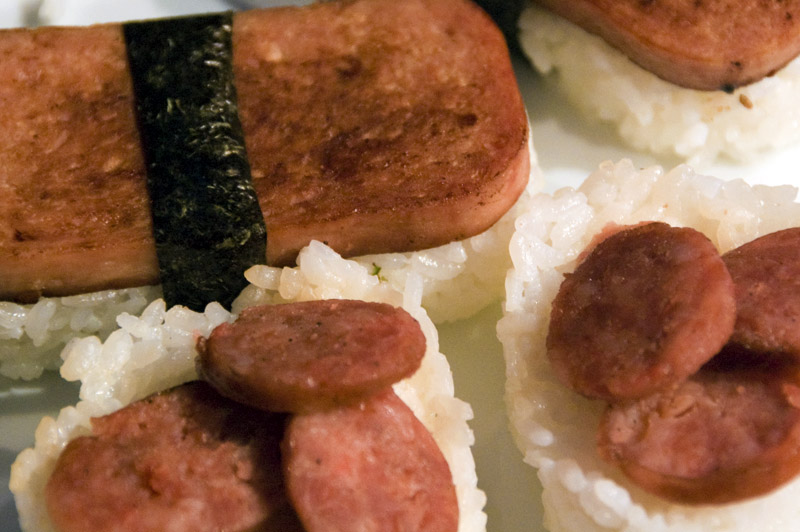
Spam musubi and Longanisa onigiri
The South Pacific has a longstanding love affair with the canned lunchmeat that's been ridiculed for decades by Johnny Carson and Monty Python. Our friend Arnold over at Inuyaki has an archive of articles on Spam. Frankly, I still find it utterly disgusting. But as soon as we saw the iconic blue can on the shelf of the Marché Manille, Alannah and I turned to each other and said in unison, "Spam musubi!"

Musubi is another term for the Japanese snack onigiri. (Many Hawaiian dishes, I've found, are derived from what I grew up with as Japanese comfort foods.) It's basically a bundle or brick of cold or room-temperature rice stuffed or topped with some sort of non-rice substance. In this case, that non-rice, non-food, non-organic substance is a fried slice of Spam. And it's magical. You can eat it warm. You can eat it cold. You can probably eat it 20 years from now.

NOTE: As conscientious foodies, we try to buy as much organic/locally produced/artisan product as possible. While it's still somewhat inexcusable, we were relieved to learn that this UK-sourced Spam is actually made under license in Denmark using European hog parts. For what it's worth, at least it's all EU.

Of course, with the guy at the Filipino store having hooked us up with some of his buddy's homemade Longanisa, we had to honor his coolness by making some onigiri with said sweet sausage as well. Not to mention it's perfectly fitting, as Filipino foods are as much a part of the Hawaiian melting pot as Japanese, Chinese and mainland. (Or so the menu at the L&L Hawaiian Barbecue chain informs me.)

Despite the setback in bequeathing it with official endangered status, the recent brouhaha over the scarcity of bluefin tuna (which is rarely served or sold in the mainstream marketplace), has seemd to make the price of all tuna go up. Despite the rather ridiculous prices, when I saw some beautiful, deeply-colored, sashimi-grade tuna at our local Sunday market, I had to pony up. All for one dish that'll get hoovered up in two seconds: Poké.

Don't worry, it's not endangered bluefin. We can't afford dat shit, brudda.
Poké is a Polynesian variant on sashimi or ceviche. You take your fresh fish, slice it up into strips or dice it into cubes, and let it marry with a blend of soy sauce, sesame oil, chilis, and sweet onion. Simple but fantastic. Like with many raw fish dishes like ceviche, it goes really well with a contrasting side like guacamole – or simply sliced avocados. But it's good enough to have straight up. I like to think of it as the steak tartare of the sea.

These cucumbers are here for the sake of not dying
of heart failure before the meal is over.
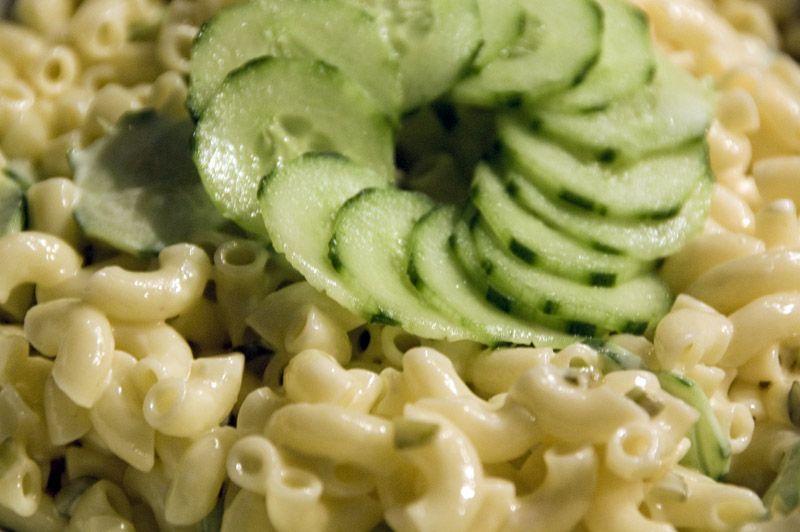
Going by experiences like the aforementioned L&L (or San Francisco's legendary Hawaiian sit-down, Da Hukilau), no platter of Hawaiian food is complete without a rich, mayonnaise-y macaroni salad. Like Spam, mayonnaise is one of those things where it takes an exception for me to like. Those exceptions are Japanese Kewpie-brand mayonnaise and the homemade stuff.

For this salad, while Kewpie would've been perfect, we simply went with making our own, which is easy: Hand-beat the ever-loving crap out of one egg yolk with a touch of vinegar, slowly adding standard salad oil (olive, peanut, etc.) until it gets to the volume and consistency you like. The approximate ratio is around 200ml (just under one cup) per egg yolk. You can use a machine, but everyone knows a good whipping by hand is where it's at.

We used less mayo than we're accustomed to from Hawaiian joints back on the Left Coast, and even lightened it up with some thinly sliced Japanese-style cucumber to give it some freshness.
Heart attack on a plate.
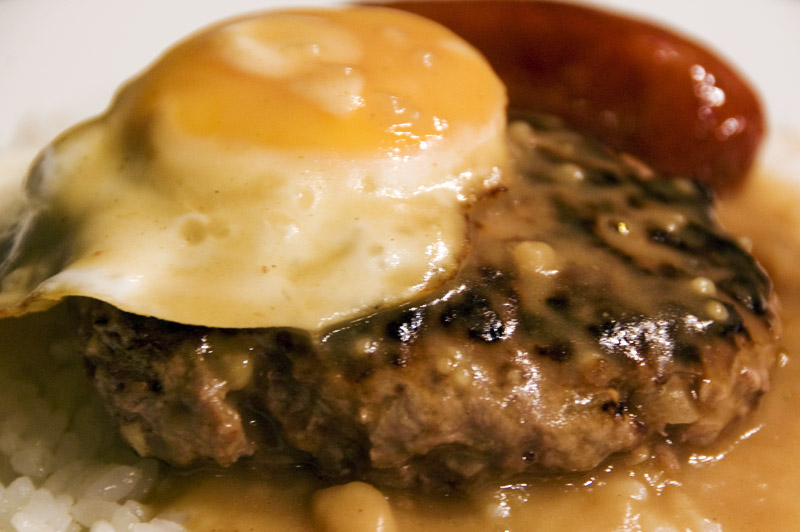
Of course, a cholesterol-heavy side dish needs an even more fat-laden main course to accompany it. And there's no Hawaiian meal easier or more satisfying to make than loco moco. Take a pile of steamed Japanese rice, top it with a hamburger patty, top that with a fried egg, and then smother it all with brown gravy. If you're insane like we are, add a link of longanisa on the side, just to seal your doom.

This was no ordinary loco moco, though. We used top grade Japanese rice made in filtered water, grade "01" eggs (the top French classification for free-range, cage-free, blah blah blah), and freshly ground steak from our local butcher (that I'd mixed with finely diced sweet onion). The result was the most amazing tasting loco moco we've ever had – largely due to the crazy hambagu steak (as they'd say in Japanese) patty. After the musubi and the onigiri and the poké and the macaroni salad, this was all just overkill.

But, well, that's what a Hawaiian feast is all about. Celebrating the abundance of starch, flesh, fat and sugar that can find its way on to an island chain in the Pacific. Or the Ile-de-France region around Paris.

That's kind of sort of an Island, right?

22 March 2010

Hot Mother-Daughter Action

After an overdose of my Iranian half of culinary heritage for Norooz, it was time to balance it all out by engaging in some Japanese debauchery. No, not anime featuring demon tentacles, uniformed school girls, and odd forms of penetration. We're simply not into that hentai stuff. But my other ethnic half's perversion doesn't end with used panty vending machines.

In fact, everyday Japanese weirdness isn't so much perversion, but an almost innocent frankness that turns out to be – like all things Japanese – very cute. Naming foods, for example, is subject to this cute-ification. Take the dish known as shirako for example. That would be fish milt. Milt is sperm. Shira is a prefix meaning white. Ko is a suffix meaning child. Sperm is white, and makes children. Hence...

Alas, there will be no eating of sperm this episode. Instead, we're talking about oyako donburi. So donburi is the common term for rice bowl (as in a bowl of rice with food on it, not unlike a teriyaki bowl). You just learned that ko means child. Oya? That means parent. Parent-child rice bowl.

Obviously, this is more of a metaphorical description of the dish. But it's not far from literal. The primary components of oyako donburi are the chicken and the egg.  We're not going to argue over who comes first. (Who cares as long as both do?)  We're going to tell you how this deliciously morbid-sounding familial dish is done.

To top each bowl of steamed Japanese rice (please don't use jasmine rice or Uncle Ben's - that only hurts me), you will need a chicken breast, 2 eggs, half a sweet onion (or three green onions), and a cup of sauce. The cup of sauce is comprised of 180 ml (1 cup) dashi (bonito stock, look it up), 2 tablespoons each of soy sauce and sugar.  Those are your ratios, and the only ingredients you actually need.

Heat up a skillet and pour in your cup of sauce.  Toss in the chicken breast, cut into thin strips manageable enough for chopsticks, not unlike a stir-fry.  Let the chicken simmer in the sauce 5-7 minutes over medium heat, then add your onions. After a few more minutes, when your onions have started to soften, pour in your slightly beaten eggs over the top of the chicken-onion-sauce concoction. Do not mix.

Scoop your hot, steaming rice into your bowls, and while the eggs are still runny (but not totally raw, eww!) use a large serving spoon to ladle it out on top of your rice. Optionally, before scooping it out, you can sprinkle it with strips of yakinori (roasted seaweed in sheet form, like what's wrapped around sushi rolls).

Serve while piping hot. The egg will continue to cook and will be ready by the time you get it to the table. For a touch of color, I added a garnish of aonori (green seaweed flakes), but some argue that over-garnishing a donburi will detract from its purity of flavor.

The Real New Year

Ladies and gentlemen of much of the world: You are party to a sham. While you have been celebrating the arrival of a new year on some arbitrary, cold winter day (ok, unbearably hot summer day in the southern hemisphere) those crazy mofos in Iran have been doing it right, celebrating the new year when it actually feels like, well, a new year. That would be the first day of spring, or as we like to call it in the Axis of Evil, norooz. (Or nowruz, or nohruz, or whatever... نوروز)


Yes, that's right, the people your media has led you to believe are a bunch of self-flagellating religious zealots in search of nuclear weapons actually celebrate the world's oldest pagan ritual in a very colorful manner, and it's a very big deal. Ok, some of us do wear a lot of black and get into the whips and chains, but not in the way you see it on CNN. But come this time of year, it's all about Norooz. The Vernal Equinox. The Rite of Spring. March 20, 2009 at 17:32 GMT. Whatever you want to call it, there's only one way to properly celebrate it: Copious amounts of food. (It's the Iranian way.)

Haft-sin: The traditional Norooz spread made of seven (haft)
items that begin with the Farsi letter S (sin).
No, you don't eat these.

Luckily, my wife likes being stuffed with a whole lotta Persian. So much so that immediately after we got together, she started learning how to make the stuff. Don't tell my dad, but some of Alannah's dishes are even better than grandma's... But Iranian cookery is complex. So we'll start with the simple stuff, as we did for this Norooz: Maast-mousir. Essentially, it's yogurt with minced elephant garlic and a dash of salt to taste. Maast is yogurt, and mousir is the elephant garlic, often badly mistranslated as shallot.

Elephant garlic is tough to come by, although some Trader Joe's stores carry it in cute little wooden baskets in the US, and in Europe it can be found in Middle Eastern stores under names like "Oriental garlic" or in French "ail de cheval." As is often the case with Iranian food, using anything else simply does not work. This is a very stubborn, persnickety culture.
Maast-mousir
Heart on.
The dish is typically served as an appetizer or snack. It looks absolutely non-descript, but the elephant garlic packs a pretty powerful punch. And, of course, the tang of a real yogurt (not that runny, sweet Dannon crap) carries its own dimension. But you don't simply spoon it up. If you order it at an Iranian restaurant (half of whom use regular garlic, rendering it too hot and utterly inauthentic) it will be served with lavash flatbread. But in just about every real Iranian household – and Iranian-Japanese-American households in France – it's best eaten with that über-Persian form of carbs: Potato chips. That's right. Take an ancient dish made with an elusive wild leek bulb... and scoop it up with plain potato chips. If you want to feel more exotic, call them by their French name: Chips à l'ancienne. Classy, no?

Next stop, salade Shirazi. Which means "salad from Shiraz." We're only moving up slightly in complexity here, finely dicing sweet onion, tomatoes, and Persian cucumbers. Despite the opposite being the case in figurative, innuendo-loaded terms, Persian cucumbers are much smaller than the usual English cucumbers, thicker skinned, and bitter on the ends. So when prepping them, you should chop the ends off and peel the skin in stripes – you want to leave some green for both appearance and taste. The dressing is simple: Lemon juice, olive oil, and salt. I like to add some dill and black pepper.
Salade Shirazi. Do not add Feta cheese. That's Greek, not Persian.
And no, 300 was not an accurate portrayal of either culture.
It's best to only lightly dress the Shirazi. The vegetables' own juices will leech out after a short while, both adding a sauciness to the overall dish, and toning down the acidity of the dressing. This is a huge problem at restaurants, where the salad has been sitting in a mixing bowl all day: By the time it's served, it gets very soggy. So if you plan to serve this, don't add the dressing until maybe 15 minutes before dinner time.

So far, neither of what we've made is mandatory Norooz fare. The main course, on the other hand, is. Sabzi-polo va mahi quite simply means "herbed rice with fish." Typically the fish is a white fish of some sort, but we went with salmon... Mostly because that's how my parents sometimes did it, because growing up it was hard to get any sort of brackish water white fish that was up to their standards. (Again, Iranians are very persnickety about ingredients. And apparently so are Japanese wives of Iranians. And now by osmosis, American wives of Japanese-Iranians.) It actually does not matter. The important part is to get good, fresh fish, dredge it in flour, and fry it in a skillet without drying it out. To give it the proper golden color, drizzle it with a mixture of lemon juice and saffron.
Sabzi polo - mahi
As for the rice, I could write an entire volume on properly preparing Iranian rice – which is pretty much Indian basmati rice about 99% of the time, but basmati taken to an extreme of perfectionism. It is the most persnickety of persnickety food components, and the technique takes half a lifetime to perfect. To be frank, I still suck at it at times, and Alannah is still learning. It's a long, drawn out process that requires parboiling the rice until just a shade crunchier than al dente, rinsing and cooling it, then very slowly steaming it until it's relatively dry and fluffy. The trouble with sabzi polo is that you're introducing a melange of herbs in the steaming process - chopped flat-leaf parsley, coriander (cilantro), chives and fenugreek, as well as thinly sliced garlic. These bear both water and weight, making it more likely that your rice will come out less than fluffy – and possibly soggy! The necessary adjustments come naturally after making the dish many times, knowing your rice (stick with one particular brand for consistency!), knowing your pot, and knowing your stove. Seriously.

Then there's the matter of making part of your sabzi polo yellow with saffron. This is done by stirring the desired amount of rice in a mixture of saffron and hot water (this is after the parboiling and draining) and lining the bottom of your pot with it for the steaming round.

Speaking of the bottom of the pot, one can not forget the tahdig. Which means – wait for it – "bottom of the pot!" This crunchy layer of (saffron-infused) rice is the golden ticket in the crazy Wonka land that is Persian cuisine. You spend years perfecting the perfect white, fluffy rice... only to crave the hard, crackly crust at the bottom of the pot.
A perfectly round bottom.
Tadig is served as a side dish, or sometimes – if the stars align and it comes out perfectly – the entire pot of rice is flipped on to a serving dish with the tadig on top, kind of like some sort of basmati upside down cake. Tadig can also be made with lavash flatbread or sliced potatoes (kind of like chips) lining the bottom of the pot. Either way, successfully making a good one is analogous to an American cook roasting a Thanksgiving turkey without drying it out: It'll be what every dinner guest will talk about. "Did you see that tadig? Perfection!"

Of course, in Iran, one is never done playing with saffron and rice. (Personally, I would play with Saffron every chance I got!) A festive holiday dessert is sholeh-zard, which literally means "runny yellow." It's a pudding consisting of basmati rice, sliced almonds, sugar, rose syrup and about US$500 worth of saffron per serving. Perhaps I'm exaggerating a bit, but as pointed out in our Drunken Paella episode, real saffron is not cheap. It is, by weight, more expensive than gold, cocaine and possibly printer ink. Half a teaspoon usually goes a very long way, but if you have Iranian guests and really want to impress them, your sholeh-zard needs to be more golden than a shower with Kim Kardashian.
Sholeh zard. Not as runny as the name implies.
Sholeh zard is typically served chilled (but not cold, as the saffron scent would be too muted) with a dusting of cinnamon and chopped pistachio on top. Fancy people like to write things in Farsi with their cinnamon, but I find that a bit lame. (Sorry, Mom!)

Of course, an Iranian host(ess) would have no credibility if their hospitality didn't reach a certain level of overkill. So it's always best to have a second dessert ready. For this occasion, we made halva. Like most Persian cooking, it's relatively simple in concept, but maddening in detail.

In a dry skillet, you toast flour... Once browned, you add an almost equal amount (in weight) of butter. We went off-script and used a demi-sel butter as opposed to sweet, which means that if my grandparents were alive today, we'd be disowned and written out of the will. The brown roux you've created needs to slowly cook over very low heat. Once cooked, you add a hot syrup of water, sugar, rose syrup, saffron and green cardamom and whip it until there are no possible lumps. The mixture is then poured into a dish to cool, with chopped pistachio sprinkled on top.
Halvascape.
Of course, the halva is not eaten alongside the sholeh zard. It's the second dessert, meaning it would go best with your tea! Iranian tea is quite parallel to Iranian rice: There's an over-complicated preparation process, people are really persnickety about how it's made, and the principle ingredient comes from India – in this case, Darjeeling and Assam tea leaves. We added some green cardamom to tie it a bit to the halva, and also because my grandma would've approved.
Halva and Chai
Incidentally, the Farsi name for tea is "chai" just like in India. In China and Japan, it's cha. That whole Silk Road connection is pretty amazing, eh?

With few exceptions, Iranian food is very colorful and aromatic, whether you're celebrating the arrival of a new year or not. None of what we made is specifically for Norooz: While the sabzi polo – mahi is mandatory, it's also eaten year-round. So really, every day is a colorful celebration. Each dish has colors that are a tribute to various forms of what the French call terroir. It's a cuisine full of life, vibrance, and color; fiercely proud of where it comes from, resistant to meddling, and more ubiquitous than you'd likely think – just like the people.

Persian culture is not about head-to-toe veils, headscarves, big beards or turbans. More than anything it's about pride. Generosity. And eating really, really well.

Saal-e no mobarak!

03 June 2009

Drunken Paella

It wasn't quite a lost weekend, but definitely a hazy one. We wore ourselves out pretty nicely, but now we've almost recovered enough to get back to the business of exposing ourselves.

The mercury was pushing 30ºC in Paris and the air heavy and balmy, with plenty of sunshine. It's as though someone forgot to remind Mother Nature that the weather here is supposed to suck hard, then unexpectedly snowball you. Such weather calls for just one thing: Hot, sweaty sessions of day-drinking.

Before starting our Sunday session of boozin' in the sun, I prepped everything I could to make a proper paella mixta after coming home later. After lubing up with a beer and bloody Mary first, of course.


If you've done the necessary prep work (the bulk of which is just measuring out your ingredients and having them at hand), making paella is easy. Even hammered. Hell, even without a proper paellera (paella pan).

Take a wide, shallow pan, heat it up, and throw in a few tablespoons of olive oil. Throw in a bunch of whole prawns (or crayfish or langoustines... something with beady eyes, meaty tail, and tasty guts) and heat until nice and pink/red. Set aside.

Now throw chunks of Spanish chorizo into the pan (Mexican chorizo isn't quite the same, but you can do that if you like) and brown. Set aside.

With the pan still going, throw in a mixture of very finely chopped onion, a crushed garlic clove, and if you feel like it, a small tomato that's been beaten to a pulp. (Don't bother with the canned stuff.) Maybe a dash of sweet paprika. Once they're nicely sweaty and soft, throw in two cups of rice and sauté in the mixture until browned.

Pour in 3 cups of seafood broth. Or in my case, I had only made 2 cups of broth (basically by boiling and straining the carcasses of around 2 dozen previously cooked and eaten shrimp) and added an additional cup of water. The homemade shrimp broth is awesome and simple. If you can't swing it, use chicken or vegetable broth.

Get the heat up nice and high until the broth starts to boil, then turn it down to a medium low and let it sit for about 15 minutes. At that point, most of the water should be gone and your rice should be al dente.

Grab a healthy pinch of saffron (the real shit, not that turmeric-infused powdered orange trash) and mix it into the rice. I prefer to grind mine down with a pestel and mortar first for even distribution and to get as much scent and color out of it. Re-introduce the sausage to the pan and mix in as well. Press your filter-feeders into the rice and make it look pretty.

Crank up the heat under your pan to high, in order to form a light crust at the bottom. You'll know it's good to go when you smell a slight burning scent. It should take less than a minute.

That's it! Some people like to finish it in the oven, which I did to get a little extra "roast" on the prawns from the broiler. It gives them that just-barbecued-on-the-beach feel.

Trust me, you can easily do all of the above while completely tanked. In fact, it will come out even better when you're in a less inhibited state of mind.

Case in point: After drinking all day, I got to the step that requires a "healthy pinch" of saffron. Apparently, after numerous cocktails and beers, you don't think twice about dumping half a container of real Iranian saffron into your paella. Since it's not polite to discuss finances, let's just say that good saffron makes uncut Colombian cocaine look like a bargain.

While you may want to kick your own ass when you sober up and realize you just used up half a college tuition's worth of spice, the memory of saffron flavor exploding all over your tastebuds and olfactory senses makes it forgivable.

Hell, even if you don't follow our drunken lead, a good paella is still easy and surprisingly simple. And you can make it with just about anything - chicken, rabbit, mussels, clams... Even vegetarian if you swing that way.

Of course, there's never too much of a good thing. Keep your buzz going by enjoying your paella with a nice old-vine Garnacha from Spain. It's the hotness as wine goes right now, and dirt cheap to boot.

01 May 2009

Sloppy Seconds: Fun With Curry

What to do with a massive amounts of leftover Omid's World Famous™ Japanese Curry? Why, have fun with it, of course!

Despite making an enormous pot of the stuff (much of which was summarily consumed on the first night), we didn't have enough to invite our favorite bikini-clad food fetishists for an evening of sploshing. Instead, we further Japanese-ified it.


Omu-rice (or omrice) is a Japanese contraction for "omelette rice," a lunch favorite often creatively slathered in ketchup, served to kids or businessmen too busy for a real lunch. (This is a very common phenomenon in Japan.) Essentially, it's rice (sometimes garnished) rolled into the middle of an omelette. To give it some real Japanese flavor, add a little bit of dashi (bonito stock) and sugar to the beaten eggs... We mixed some leftover rice with the leftover curry, heated up the mixture, and laid it inside the thing omelette exterior, all the while giving the ketchup a pass.

Simple. Pleasure.

The next incarnation of the leftovers is essentially the same thing: Curry, rice, and egg, arranging it in what could only be called the "Curry Volcano."


This time, we decided it was about time to try our hand at the onsen tamago (hot spring egg), a slowly soft-boiled egg that's just a shade on the cooked side from raw. Unfortunately, our thermometer is a damned liar, and despite reading around the 65ºC mark during the soft-boiling of the egg, it came out undercooked. Or rather, practically raw but warm, with the white becoming a slimy puddle of goo resembling... coagulated corn starch. (What did you think I was going to say?)

No matter, because the stuff all gets mixed into the hot curry and rice and cooks anyway, making a rich, satisfying dish even richer.

28 April 2009

Sticky Sweet: Gariguettin' Off

During our few days off from cooking last week, I still couldn't help but bring home a new toy to play with.

We went to see F. (drug dealers' names should never be disclosed) at our favorite Parisian crackhouse, E. Dehillerin. A mecca for foodie tourists, wannabe chefs and – believe it or not – real chefs, it's another one of those awesome local places that Alannah somehow gets preferential treatment.

I don't know how she does it, but if it gets us a new plaything, I don't care.


It's a passoir à grosseilles, which literally means "currant strainer," but going by F.'s disapproving look when I told him I wanted to liquefy some cooked vegetables through it, and his nod and smile when I said, "I mean, coulis!", purists (like F.) think it's only intended for processing fruit.

Somewhere between a chinois and a food mill, the passoir à grosseilles uses a shiny blade and rolls on a wooden bearing to push and squeeze food through a fine sieve. I couldn't wait to make my first coulis.

Unfortunately, this took days. Alannah rolled her eyes every time I went up to a complete stranger to sniff her berries. Touching the merchandise isn't always acceptable behavior by French standards, so it was a challenge going around and sniffing for ripe berries in early spring. We finally happened upon the ideal berry: The gariguette.

The gariguette is a uniquely French phenomenon, a rare springtime strawberry with intense scent and flavor that unfortunately a) has a very short season and b) costs more than most designer drugs. Legend has it that they only grow in the South of France and usually are sold to overpriced restaurants, Michelin-type chefs, and rip-off specialty markets. In reality, you can buy them at most decent Parisian marchés, but they're few and very expensive. Not being made of money, I just happened to spot a good deal at a heretofore undisclosed location (sorry local readers!) who apparently don't know what they're selling, because they cost less than the hideously bland, gigantic Spanish strawberries that are common at this time of year.

By the time we got home, I was gagging for it. A weird new toy, a basket of legendary strawberries... We simply had to make something – something incorporating fresh strawberries and a sauce, but that won't outshine the fruit.


And voila! Rice pudding with gariguette coulis and the self-same strawberries on top.

The rice pudding is plain old, humble vanilla rice pudding (sans egg). The strawberries on top? Delicious as expected. The real star here, sandwiched in the middle, is the coulis.

We'd read that gariguettes have intense flavor, but this is bordering on ridiculous. Sweet, sticky, and mindblowingly perfect.

The strawberries were cooked in a little bit of water and sugar, then pressed through the passoir, which secreted a clear, red viscous liquid. That was then further reduced in a saucepan until it was a bright red syrup - no coloring, no gelatin. If we were to feed it to you, you'd think it was from a bottle of concentrated strawberry syrup, and you wouldn't believe it was anything more than real strawberry and sugar. Even the dull-colored pulp left in the passoir - looking like strawberries that had been chewed up and snowballed out - tasted like the most intense strawberry jam. We just licked that off a spoon before assembling dessert.

In the afterglow of a perfect gariguette sauce, we're left wanting more, wondering what else we can make from these amazing little strawberries. We only have a handful of weeks left to find out!

27 April 2009

Sensory Overload: Karaage Katsu Curry

The Japanese gang bang continued this week, as the other night we made a giant batch of Omid's World Famous™ Japanese Curry.

Now any person with kitchen competence and access to S&B (or similar) curry mix can make a decent Japanese curry. The beauty of it is that, like Lady Gaga, it's a tasty no-brainer that goes down easy. What sets mine apart? Years and years of perfection - that, and I can make a perfect base from scratch. This is actually a wholly unnecessary, time-intensive skill - even the chefs at most curry houses in Japan will use blocks of packaged curry base - but it's important if you like to cook without unpronounceable chemicals, or need to feed some vegan friends who won't eat something with traces of beef stock in it. (Last I checked, a jar of Knorr's didn't moo, hippie.)

All vitriol for air-headed pop tarts and irrational animal-worshippers aside, making your own Japanese curry base isn't that important. What is important is handling the ingredients before they're ever stewed, and then having the patience to let it all slowly simmer and reduce for hours on end. Part of my approach is to season the vegetables (and meat, of course) while it's in the sautée phase - adding garam masala, ginger, garlic, and chili while it's all browning. This ensures that all the chicken/beef/carrots/potatoes/mushrooms/whatever are nicely infused with flavor. Then there's the simmering... Not only do the hours on the stove reduce and thicken the curry, but the starches from the potatoes are released into the mixture, further thickening the stew.

Alannah's gotten a firm handle on my long-and-slow approach and can now tantalize the tongue with the best of them. So it was time to step up the game. To bring OWF™JC to another level. And that level, ladies and gentlemen, is the addition not of a regular old katsu (schnitzel) on top, but a karaage chicken katsu.


Karaage (or kara-age if you need your double-vowels separated for you) is Japanese style fried chicken – though the name pays homage to the Chinese style of frying. The key isn't so much how it's fried, but the fact that the poultry has been marinated in soy, ginger, and garlic. And of course, the not-so-secret ingredient approved by binge drinkers who swear it won't give you a hangover: Sake. I prefer hon-mirin, fortified sake, but any sweet booze will do. 'Cept maybe Schnapps.

The other key to karaage is to fry it coated in a starch (potato, to be exact... but corn is fine in a pinch), but we opted for the more katsu-like egg and panko breadcrumbs to give it a more traditional look and feel. The crunchy panko nooks and crannies perfectly hold microscopic little bits of curry, ready to explode in your mouth with flavor.

The combination of these two ridiculously awesome examples of co-opted Japanese food may seem like a bit much. Overkill, you might say. And it's all the better for it. These are the two most more-ish Japanese dishes there are.

You will keep eating karaage chicken even when you're full. The stuff is often served up in heaps along with beer, and by the time you notice your stomach's distended to the point of rupture, it's too late... and you order another plate.

The curry makes karaage seem like a mere gateway drug, its addictive properties (not quite scientifically) proven to be greater than that of crack, heroin, or reality TV. I have been seen (and probably photographed) licking the last bits of Japanese curry off of plates, hunched over like The Hedgehog going to town on a teenage runaway.

This combination is the speedball of Japanese food.

Which got me thinking... Say we work these two into a new dish involving okonomiyaki... It could be the three-way of a lifetime.

Of course, when this happens, I'll tone down the spice. I reached for a red jar off the spice rack when doing the initial sautée of the curry ingredients. But instead of the usual pissweak French "chili" powder I've grown accustomed to (and using in massive quantities), Alannah went and got the real stuff from an Indian market. Oops. Let's just say I haven't felt this kind of burning since Spring Break was still legal in Palm Springs.

25 April 2009

A Whole Lotta Wiener

Sometimes you just need some wiener.

And it's really hard to say no when it's only 1€80 a 10-pack at the local convenience store.

The humble hot dog sees a lot of abuse. It gets slathered in ketchup. It gets served with cheap canned chili. In Paris, it gets baked into the bun forming some sort of disgusting 4-day old bagel dog sold alongside pre-made crêpes near tourist traps.

We have nothing against cheap convenience foods. And this week, with both of us having had a lot of work, going to the butcher or fishmonger or green market wasn't an option.

Cheap and Trashy
One thing you really appreciate after leaving the US is good ol' WT food. Especially on a hot day (by local standards, to which we've become acclimated, anyway) where you just want to grill some hot dogs or factory-produced burger patties and have a tub of potato salad from Safeway or Costco or some other place a foodie would look down his nose.

Of course, living in a 300+ year-old building with no back yard means no barbecue. (The French don't take kindly to having their historical neighborhoods burnt down by Americans longing for a good ol' cookout.) So Alannah improvised with our ridiculously effective broiler, roasting some wieners that I could swear tasted like they came off a Weber kettle. Look, she even made grill marks!


Alongside it, a gigantic mound of potato salad. Here's where we went back to our usual selves... I've never really cared much for mayonnaise. Unless it's homemade or Kewpie brand mayo from Japan. In this case, we went for making our own Japanese-style mayo. It's a bit lighter and sweeter than regular mayo, and unlike French mayo, isn't infused with mustard. It's pretty simple - egg yolks + rice vinegar + cider vinegar + salad oil + a pinch of sugar. Then work it like crazy with a whisk, 'til you've got a gooey, creamy sauce ready to be slathered over potatoes.

Japanese Wieners
Not letting anything go to waste, we once again leaned on the hot dog crutch the next night, this time to make Japanese food. This isn't out of the ordinary - when we had relatives visiting from Japan last fall, they taught us a bunch of their favorite dishes. My aunt kept adding at the end of each dish, "Oh, and it's really good with hot dogs!" Being an old divorcée with adult kids who've long left home, I suppose she was all about finding new ways to enjoy wieners.


In that spirit, we put together a hot dog donburi. A donburi is a big bowl of rice topped with meat, often with a softly scrambled egg surrounding it. For instance, you often see it with tonkatsu, which is a fried and breaded pork loin. We substituted a hot dog.

Unfortunately, beaten egg and panko bread crumbs don't really stick to the slick, smooth surface of hot dogs too well, so there was a gloppy mess of wiener to be dealt with. But in the end, it worked out... and was surprisingly tasty.

And Some Balls, Too...
When our Japanese contingent was visiting, they'd brought us a takoyaki pan - a cast iron pan with golf ball-sized wells to make the eponymous Osaka snack. The batter is similar to okonomiyaki, based on the slimy, white, viscous nagaimo (or yamaimo if you can dig some up), only without the cabbage. This time around, I'd made some tenkasu (little fritters of tempura batter) to bolster the dough, lest you want the takoyaki balls to come out flaccid and not hold their shape.

Naturally, instead of cubes of boiled octopus, I loaded up each ball with a piece of hot dog.


Sadly, cast iron takoyaki pans and typical French vitroceramic electric ranges are not a marriage made in heaven, so a half dozen of our balls were essentially culinary abortions. The other ten, however, came out perfectly spherical, brown, and delectable.


I put them into pyramids topped with the customary aonori, katsuoboshi, mayo, and a sweet soy/vinegar sauce. A little yakisoba on the side (with sliced hot dog, of course), and some potato salad, and this was almost an authentic Japanese meal.

Next time, we'll preheat the takoyaki pan in the oven and perhaps put it over the ninja stove (sadly our only way to cook over gas) and see if we can get a full set of balls to bite down on.

20 April 2009

A Little Bit Zen


We were both feeling a little worn out today... After a full day of work and a bit of umami hangover from the previous night's orgy of ingredients, it was time for something a little more simple... Cleansing... Redeeming?

A small cup of green tea, a stripped down bowl of miso soup, and one small bowl of rice's worth of onigiri for each of us - the prescription made for a gentle return to the work week.

Of course, simplicity doesn't mean blandness. There are as many types of onigiri as there are perverts wanking it to demon schoolgirl hentai anime in Japan... So we went with three: A small furikake ball (toasted sesame seeds, nori, and seasonings), flanked by one filled and topped with komochi konbu (kelp with kazunoko herring roe)...


And another sprinkled with yukari, a combination of dried shiso leaf mixed with bits of the puckery, salty umeboshi sour plum...


Internal Shots
Of course, much of the pleasure of onigiri comes not only from its fun shape lending itself to finger play, but also what's inside. Cutting into the komochi konbu one reveals even more of the brackish kelp and the pops-in-your-mouth kazunoko.


And tearing into the other little mound reveals a small but powerful infusion of pickled umeboshi mixed with okaka - itself a mixture of katsuobushi bonito flakes and soy sauce.


The best part is that it's also easy. And if you do it with a big batch of rice, the little rice balls keep quite well. Just store them loosely covered at room temperature, and they're perfect for a quick lunch or on-the-crazy-fast-train snack the next day. Don't live somewhere with fast trains? Sucks to be you...