Showing posts with label chocolate. Show all posts

23 July 2010

It's It! Sweetly Sandwiched San Francicso Style

Alannah and I recently set out on a mission: To represent San Francisco in Paris. The reason is two-fold.

First, as San Franciscan transplants with an inferiority complex, we're sick and tired of anything remotely American here being described as "New Yorkais." Local writers have recently described a chef from Chicago, a coffeehouse owner from Washington and freakin' burritos as New Yorkais. Dubya. Tee. Eff.

Secondly, we don't really know of many people reppin' the Bay. There's Andy at our local favorite sushi joint Rice and Fish who's doing it right, and there's... uh... wasn't Alice Waters supposed to open a restaurant next to the Louvre some time back? Then you've got your French folk like Loic Le Meur (Seesmic, Sarkozy spokes-ass) and Benjamin Tremoulet (H.A.N.D.) who spent - judging by their products - about four hours in California and decided to build their businesses around their (in)experience and trust funds.

So we've got some projects in the hopper, hoping to bring real streetfighter SF culture to the old-school dining mecca. We talk a lot of shit, but we also put our money where our mouths are. And right now we're finding a lot more shit than places we want to put our mouths.

In the meantime, if we wanna make a wave, we've gotta work on desserts! And we're starting by perfecting a premium, locally-sourced-as-possible version of It's-It ice cream sandwiches, also known as "A San Francisco Experience since 1928." Basically, it's one scoop of ice cream, two oatmeal cookies, and dark chocolate.

Alannah's quite good with dessert. Especially baking. She's gone sans oven for the last torturous month (which is about how long it takes a landlord to replace a faulty appliance 'round here...) and she's finally back in action. The "cowboy cookies" she's been making since childhood will serve as the bread in this dessert sammy.

I, on the other hand, blow fucking donkey dicks when it comes to baked goods and confectionery.

It's-It style ice cream sandwiches, take two: Not an epic fail,
but not great. You don't even want to see Round 1.
This wasn't the case nearly two decades ago. As a young punk, I used to sling out cakes and ice creams to Bay Area yuppies like it was going out of style. I'd spend a good chunk of my summer days inside a walk-in freezer, sculpting melty sugary materials that'd otherwise disintegrate in the ambient temperature. It was a good time, and I loved my customers, from local Ladies Who Lunch to firefighters to Apple and HP execs who'd sneak in between meetings for a sweet treat. One of the more distinguished among them had a particular favorite that I was proud to make: The clown cone.

That's right, I was ice cream slinger and faux-pastry chef at a fucking Baskin-Robbins. Despite being the confectionery equivalent of the guy manning the fryolator – see, any asshat blogger can puff up his irrelevant culinary past – I could write the preamble to the Constitution on the face of a half-sheet cake in buttercream, make waffle cones that could stand up to four gigantic scoops of ice cream plus hot fudge, and most relevant to our mission here, I could turn out a perfect ice cream sandwich in 20 seconds flat.

That was then. This is now. I no longer have the ability to properly hold an offset spatula let alone put a tip on a piping bag. Which is exactly what our first attempt at homemade It's-It called for. We tried the recipe and technique we Googled on Gastroanthropology. And it was a big bag of fail.

This is not to knock Gastroanthropology's technique. In fact, it's not only well-researched and professional, but if we had a proper setup it would probably work. But in a sweatbox of an apartment with merely an icebox for a freezer, it just wasn't meant to be. Ice cream soft enough to be piped out of a pastry bag would actually continue to melt faster than it could re-freeze in our piddly little freezer. And it did. We disappointingly opened up the freezer to find cowboy cookies frozen into a flat puddle of ice cream. At least the oatmeal discs were perfectly round, using the biscuit cutter technique from the above recipe.

Round 2 was much better (see photo above), but it still wasn't quite right. Instead of softening ice cream and piping it out of a bag, we smoothed a bunch of it out into a tray and froze it overnight into a sheet; much as I did back in the day to create full-sheet ice cream cakes. I then punched out discs of ice cream using the same biscuit ring so they'd be the same diameter as the cookies. So far, so good. we then dipped them in melted dark chocolate and put them back in the freezer to set. Only they wouldn't fully set. Cutting or biting into the sandwiches would result in the ice cream smooshing and the chocolate breaking off in chunks.

We put the results up on Facebook, awaiting possible troubleshooting from our foodie friends. Most of them being San Franciscans, they also know what an It's-It is supposed to be like. Our own analysis blamed not only our technique but our ingredients. In trying to make a high-quality, wholesome version of – let's face it – junk food, we just couldn't get certain things right. Using unprocessed organic oats, the cookies were too tough. Single-origin organic Peruvian chocolate? Not as easy to use for coating as the confectioners' stuff cut down with soy lecithin.

And worst of all, we had doubts about using our favorite local ice cream. I first wrote about Mary Quarta's gelato for VINGT Paris and just nabbed today's ROTD for it on Yelp (my first in over two years!) and we've been going to taste her wares at least twice a week since she opened up shop in the Haut Marais. It was the first "complex ingredient" we've decided against making ourselves (I'm even making our cheeses for an upcoming shindig) because it's so good and non-industrial, there's no point.

But gelato is a far cry in texture and structure than standard American ice cream, and it looked as though Mary's sweetness was just too soft and yielding for the type of brutality we'd put it through. We couldn't think of a non-industrial alternative, so we started thinking about how we'll make our own ice cream, solely to fulfill our desire for It's-It.

Then tonight, Round 3 happened.

Yup. Pretty much nailed it.
And we didn't have to throw Mary under the bus, either.
The difference for Round 3? A much longer freeze after sandwich assembly and chocolate coating, which itself was different. Instead of dunking and rolling the sandwiches in melted chocolate, I brushed it on thinly with a rubber spatula. Working with a nearly rock-hard sandwich to start with and making sure it went fully back to rock hard before serving made all the difference in the world. The thinner coating of chocolate didn't break off in chunks when cut or bitten, the ice cream stayed solid through most of the eating.  Alannah's excelllent cowboy cookie remained a constant. It's a bit tougher than a standard oatmeal cookie, but the taste is perfect.

Now that we've got the formula down, we're going to make a few more tweaks: The cookies will have to be slightly crisper (and possibly thinner) for easy biting. We'll have to spend even more on a high-quality nappe (coating) dark chocolate that's thinner but lecithin-free – we will NOT compromise on quality. And now having figured out how to work with Mary's super-soft gelato, we'll stick with it, but surprisingly we're going to have to find flavors even more subtle than her already subdued crème à l'ancienne. Compared to typical American "vanilla" filler ice cream, Mary's is actually too flavorful and overpowers the cookies and chocolate by just a touch.

So here's the rundown of the technique we've got down so far:

  • Spread Mary's gelato into a tray and freeze overnight
  • In the meantime, make a batch of Alannah's cowboy cookies (possibly increase butter, decrease brown sugar? She's the expert and will figure it out...) flatten using biscuit cutter as a guide, and chill/freeze 'em
  • Remove frozen gelato from tray and quickly punch out discs using biscuit cutter.
  • Very quickly assemble sandwiches, put into fridge for at least two hours
  • Double boil dark coating chocolate
  • Brush chocolate on to very frozen sandwiches (also considering dunking via wire basket if we work with a huge quantity)
  • Freeze yet again - probably overnight - in tray, sitting on parchment paper
  • Eat
It's pretty long and involved, but after blissing out on the fruits of Round 3 tonight, it'll be worth it. And the more we do it, the better we'll get at it. The material cost and the learning curve will be high, but this is going to happen. Cuz that's what it's all about, reppin' the 415: Taking the seemingly casual and humble but obsessing over quality and source, and never compromising.

18 May 2010

Dirty Dozen

Look at that tight, little star-shaped hole, glazed with sticky icky goodness.

Amateur  money shot
We're talking about doughnuts, of course. When we first started this site full of horrible double-entendres in early 2009, we did it to show off a bit of homespun food porn, starting with our attempt to make doughnuts.

In nearly a year and a half, we've come full circle. We've gotten better at finding ingredients. We've gotten better at working on techniques. And we still haven't been able to bust a decent frickin' 'nut in Paris. Sure, dozens of American (or American-style) "coffee shops" sell doughnuts, but good luck getting anything other than a hockey puck that's been sitting in a refrigerated case for days on end.

We gave up ages ago. We didn't even really eat doughnuts back in the States anyway. Then, the other night on a lark (or rather because of discounted tickets), we figured we'd go see Iron Man 2 at the shitty chain theatre nearby. Those fantasies you have of Paris being intellectual and artsy? We tossed 'em ages ago.

Anyway, there's this scene in IM2 where Robert Downey Jr. is sitting in the hole of the famous Randy's Donuts in LA, eating a doughnut. At that moment, I turned to Alannah and said, "I want a doughnut." She turned to me and said, "Me too!"

This isn't slang for a dirty act in public, but what married people actually say to each other.

The trouble is, for all the craptacular chains we've got surrounding us, not one of them makes doughnuts. The UK has imported Krispy Kreme. Spain has been invaded by Dunkin. We, on the other hand, got nothin'. So we went to bed, as we're wont to do.

At some point the next day, I looked in the fridge and saw a mixing bowl of some kind of dough.  "You didn't..." I started to say to Alannah. "Yes I did," she replied.  She'd used the dough part of some sour cream doughnut recipe on Epicurious and modified it to use yogurt instead, and much less orange zest. And it was beautiful.  She rolled out the dough and cut it into shapes.

Doughnuts and stars. Much more organized this time around.
The last time we made doughnuts, we got better results on the holes, and it took a lot of experimenting with oil temperatures and frying times. This time I bowed down to Thomas Keller's French Laundry Cookbook and used the temp and times for his "Coffee and Doughnuts": 30 seconds on one side, 1 minute on the other, and back to 30 seconds on the first at 160ºC/325ºF.

While TK's formula is for raised (yeast) doughnuts, it worked perfectly for Alannah's adaptation of the Epicurious cake (old-fashioned) doughnuts. In fact, the crumb is damn near perfection.

Exhibit A: Cross section of cake doughnut
with perfect crumb.
We made a few experimental doughnuts, as well as a bunch of holes and coated them with cinnamon-sugar for a round of overindulgent taste-testing.

A-holes and O-holes:
An Alannah and Omid production.
Having successfully completed our test round, it was time to go whole hog and make a dozen proper doughnuts. After all, American food deserves American quantities.

Nice (cooling) rack!
As much as I love all things naked, I don't care much for an undressed doughnut. I told Alannah I'd make her a nice, gooey glaze, and after she was done rolling her eyes, I actually got to the business of making some out of powdered sugar and liquid. (You need about an 8:1 ratio.)  Powdered sugar and milk with a touch of vanilla for standard glaze. Powdered sugar and maple syrup and a touch of butter for maple glaze. And powdered sugar and melted milk chocolate for chocolate glaze.

Keep your glazes warm in a bowl, dip your 'nuts in, then rack 'em for at least five minutes 'til it's all firm.  Then it's ready to shove in your mouth.

A threesome of each:
Glazed, cinnamon-sugar, maple and chocolate.
We've had several doughnuts since making the batch, and I'm already kind of sick of 'em. They're damn good, but like I said, we never really ate doughnuts that much in the US to begin with. It's just that once in a while you get a craving for something you can't have, so you just have to go out and grab it for yourself. After all, the only way to get rid of temptation is to yield to it, right?

That's what we've been doing much of the time since that first post. And we've since discovered that almost anything can be made better at home. When you do it yourself, it's more fun, more involved, and more personal. The same applies to cooking.

In fact, despite the fact that we probably won't make them again for another year and a half (and when we do, it'll be raised doughnuts!), we found that doughnuts give us the perfect synergy in the kitchen.

As the anal type (as in, she's the baker, sheesh!) Alannah's great with measurements and feeling out the proofing of a dough. As the sloppy bastard who eschews recipes, I'm better suited for the other part: Operating a deep fryer.

29 April 2010

A Sweet, Dark and Spicy Bastard

Despite our despisal of the despicable Tex-Mex places in Paris, we actually do love the bastard cuisine. It's actually one of the oldest American cuisines, the product of years of cultural exchange (or some might say subjugation or domination). We just don't like it when jerkwads try to pass it off as authentic Mexican.

Bastard food has its place, of course.

In fact, this last weekend I got out of bed a bit before Alannah and whipped together some migas, a Tex-Mex bastardization of chilaquiles: Fried stale tortillas scrambled with eggs, topped with chili or salsa, and served with a side of refried beans. (This isn't to be confused with the trendy Spanish version of migas, which is actually not the original, but a derivative of the Texan dish. Whoodathunkit?)

At any rate, this isn't about migas. This is about Alannah's insatiable craving after having snacked on my weekend treat. We had things to do and places to go, but she wanted churros. The trouble is, it was Saturday. And the only good churros we've found in Paris are sold at the Bastille marché on Sundays. (Any and all tips on how to get them on other days are welcome...) There are churro stands here and there, most notably near the crappy crèpe stands around the Grands Boulevards and other places foreigners go drinking, but good churros? Not a chance. The land of churros y chocolate may be just to the southwest, but this is a country resistant to imports.

Yes, churros are of Spanish origin. I always thought they were Mexican, because the guys selling them at amusement parks in California were Mexican. Or Filipino. But that's no way to determine food etymology, is it?

So anyway, Alannah decided to just do it: Make churros.

These churros may look fancy, but they're actually
a complete accident. Like your little brother.

The batter's like a donut batter: Flour, eggs, milk, butter and sugar, only everything's integrated warm on the stove top... She made it and then passed it to me along with a huge pastry bag. So while she went to get all hot & steamy upstairs (in the shower), it was my duty to splash around with hot oil. Ain't marriage grand?

The only problem is that we don't have a huge star tip for the pastry bag. I tried using our biggest tip, squeezing gooey strips of churro batter into the hot oil, only to get what looked like donut-fries. Which I'm sure would do brisk business in middle America, but my gal wanted churros, dammit. Crisp on the outside, chewy-tender on the inside, and hot hot hot! These pathetic little pencil-dicked strips would not satisfy.

So my Middle Eastern blood kicked in and for the next batch, I squeezed the sac and flipped my wrist in a twirling motion, as though making zoolbia (in Persian, otherwise known as jalebi in Indian/Pakistani cooking). I filled the hot oil with little disks of tightly swirled dough, the end result a golden-brown rose of churro goodness.

By the time Alannah was dressed and back downstairs, I was finishing up a chocolate sauce to drizzle over the hot churros I'd already tossed in cinnamon sugar: Cream, a lot of cacao powder, sugar, cinammon, cayenne pepper, and a few drops of melting chocolate to thicken it.

So I give you, ladies and gentlemen, Chur-rose. Churros shaped like little roses. Hot, sweet, a little bit spicy, and – best of all – a perfectly acceptable bastardization of Latin food that didn't cost an arm and a leg.

20 April 2010

Rant: Mexican't

This is a bitch & moan post with a cause. Read on for the goods.


Last night we ripped on the state of casual American food in Paris, and suggested how easy it is to make far superior burgers and pancakes than what you can find in the slew of "American Diner" themed hovels throughout the town.

Tamales with chicken and chili filling, masa-crusted razor clams,
fresh guacamole... At nuestra casa.
Unfortunately, this situation extends to all sorts of ethnic food in France. Despite being a beautifully multicultural place, what few plausible ethnic restaurants you can find are often "dumbed down" for the local palate. This makes sense in a reputedly risk-averse society, but at the same time makes no sense in the country that coined the term "vive la différence."

Nowhere is this more evident than in the realm of Mexican cuisine, the majority of which is represented by ground beef (!) burritos and insipid fajitas and so-called tacos in factory-made flour tortillas. What the fuck is going on here?  I'll tell you what: The virulent disease known as Tex-Mex, which much like anything from Texas is as irritating and unwanted as a case of syphilis. Only harder to get rid of.  The Tex-Mex trend in Paris has insured that even the most well-meaning of real, Mexican-run restaurants has to sell slushy margaritas and faux burritos to stay in business.

Despite the hardship it presents, the only decent Mexican food in town comes at our own hands. Unlike the aforementioned burgers and pancakes, though, it's not particularly easy. Some of it, like a proper molé sauce, is downright labor-intensive.  But if a guera and a chino gordo (I'm not Chinese, but that's what they call me south of the border) can find the ingredients and take the time to make the real deal, why can't the restaurateurs?

As I write this, I'm eating leftover tamales that Alannah made last night, and even nuked in a plastic tupperware container it's better than anything you can get at the local Indiana Café or Mexi&Co. Yes, the corn husks and masa are hard to source, but they exist.

Admittedly, the razor clams you see above aren't part of the authentic Mexican oeuvre. (Machas, as they're called in Spanish, seem to be limited to Chilean cuisine.) But even the most well-regarded Latin-inspired restaurants here won't dare depart from the established formula and dust some mariscos with masa crocante. They fail to educate or challenge their clientele, and instead bow to their expectations.

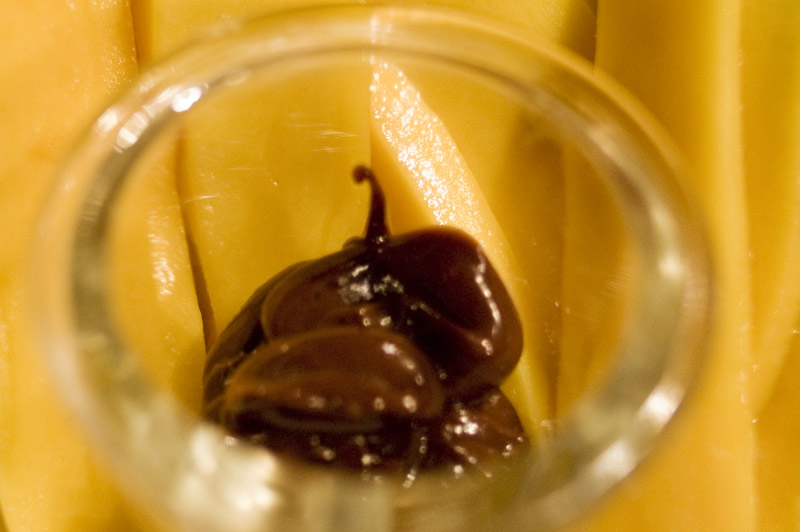
Even the faux Mexican isn't creative. In about three seconds, Alannah whipped up an accompanying dessert for last night's dinner. Sliced fresh mangos with a dipping sauce of chocolate, cream, and spices. While not authentically Latin, it at least played within the flavors of the cuisine, while offering something besides the bastardized mediocrity Parisian diners are accustomed to.

Mango y chocolate... Simple but effective.
The flavors were so fantastic, that we're going to develop a cocktail based on this improvised dessert to serve with Mexican food next time we entertain. Screw your slushy margarita.

The Good Cause Part
Luckily, there is one publicly accessible place where the status quo is being challenged.  At La Rotisserie de Sainte-Marthe in the 10th arrondissement, they have a mission: To prevent the gentrification of their part of the quartier, and to preserve the rich ethnic identity of the many small immigrant groups within.  By day they're a restaurant serving 5-euro meals to the locals. By night, they allow member non-profit organizations to take the restaurant over and share full meals (price cap: 10 euros) with the community.

Once a month, the arts collective Sonidero Tochtli hosts a Mexican dinner. This thursday will feature tacos de barbacoa, nopales (cactus) salad and a convivial community atmosphere unmatched by any other restaurant in town. (The €1.50 beer/wine might have something to do with it.)

It's not fancy. It's elbow-to-elbow seating. But the food is fantastic, and it's all done for good reason. We'll see you there.

07 April 2010

Feaster I: Hawt Chocolate

We thought about getting away for Easter weekend, but why bother? The trains would be packed, hotels expensive, and everything closed anyway. Why not take the long weekend to immerse ourselves in what we love doing most?

After recovering, we got to doing what we love doing second best: Cooking up a storm.

We've been on a Mexican kick lately, so we decided to continue the theme. Having all the time in the world, Alannah figured it was time she busted out her recipe for a pipián-inspired mole. (Pipian is a pumpkin seed sauce often eaten for Easter in Mexico.)

No mole recipe is the same. Some claim to be based on just a handful of flavors, others claim you must have exactly 38 components. Some cook relatively quickly. Others require a full day of simmering. But one thing is constant: Mole is labor intensive.

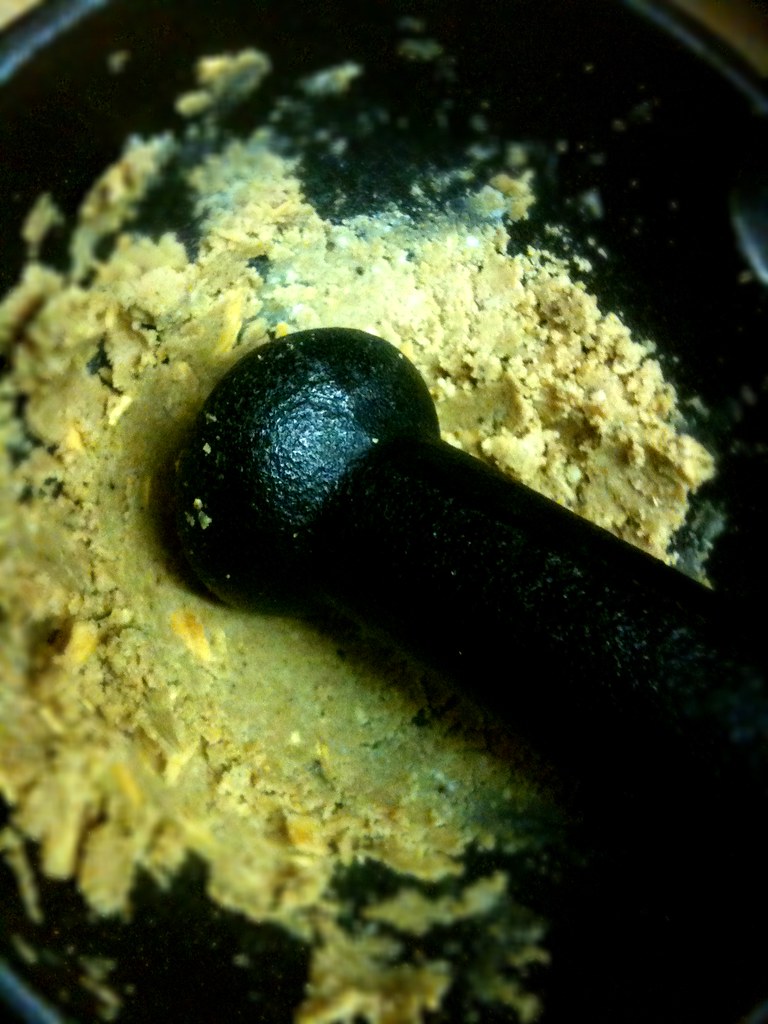
Pestel & mortar round 1: Peanuts, sesame and pumpkin seeds
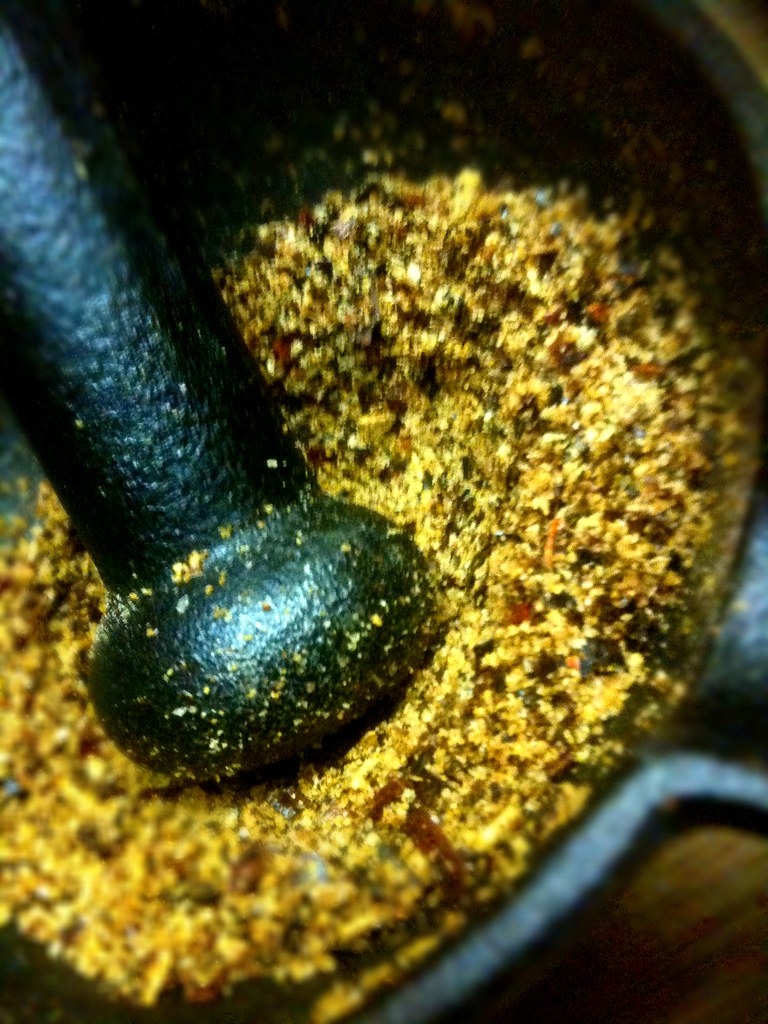
Pestel & mortar round 2: Chilis and bread crumbs
My wrist and forearm hadn't gotten such an intense workout since I was single, as Alannah had convinced me to spend over an hour grinding down roasted peanuts, sesame seeds, pumpkin seeds, chili negro, chipotle, and guajillo chilis. I remembered not to burn my junk this time.

Then it was time to simmer it in a bit of lard, add cinnamon and – the key component to a proper molé – bitter chocolate. The key is to put in just enough to give it a distinct taste of chocolate, but not so much that it tastes like you just felched Willy Wonka. This is the case at many a bad Mexican restaurant, unfortunately.

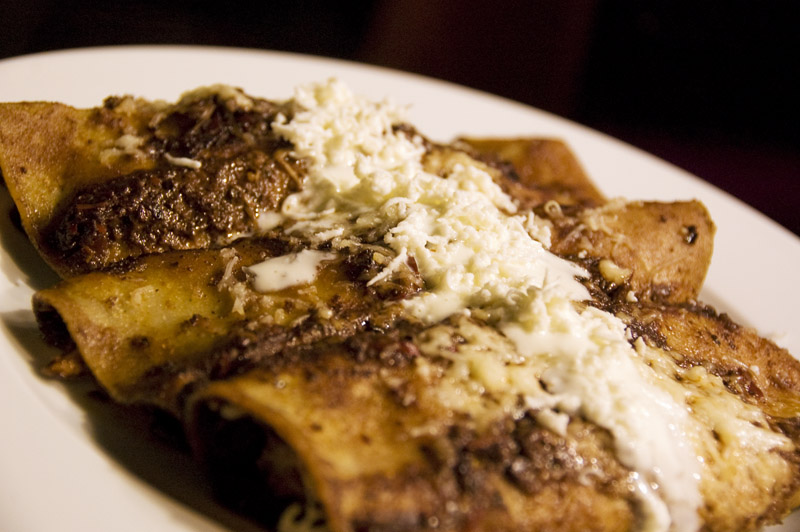
Mole can be used in many ways. The most common is to braise chicken in it. Still sporting corn tortilla's from the other night's Parisian Mexi-ventures, Alannah opted for enchiladas. So I simmered shredded chicken (thanks to leftovers from a rotisserie chicken we'd kept on hand) in the mole while she very lightly fried the tortillas. They were then given a fisting of chicken mole and some locally made queso from the Latin American store we recently found in the 9th arrondissement. Then they were rolled and laid seam-side down in a baking dish, covered with more mole and cheese, and baked for around 30 minutes.

Chocolate-chili tubes of lovin'
Crispy, saucey, and bursting with mole flavor. Mole has such an intense, complex, deep flavor that it pairs well with just about any otherwise unadorned item... Simple cheese. White meat poultry. Rice...

Chocolate Bunny
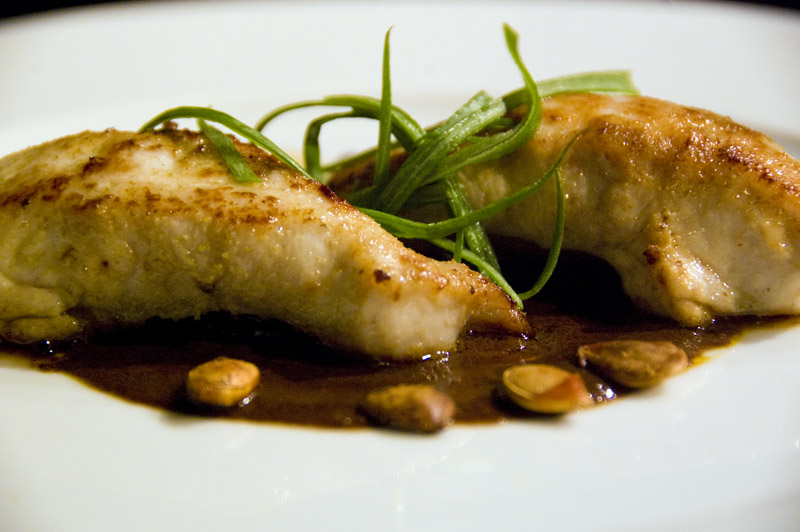
And, of course, conejo, a.k.a. wabbit. I'd initially gotten the idea for this when joking with an otherwise vegetarian friend in California who had tweeted that she was making lapin à la moutarde for Easter. I said she should stew it in mole and it'd be a chocolate bunny. Get it? Har. Well, my fancy wannabe haute cuisine food geek got the better of me. I passed the mole through a chinois, laid strips of rabbit filet over it, and garnished it with steamed strands of spring onion for a bit of Easter grass. To go back to Easter's pagan roots and symbolize fertility, I added a second garnish of pepitos – fried pumpkin seeds coated in lime and chili.

We didn't stay high-brow for long, though. To add some sort of vegetable to the meal, I whipped up a huge batch of guacamole. This is no big deal for a Californian, but even in avocado-rich France, it's nearly impossible to find a good guacamole outside the home. At best, you get real ingredients that have been abused in a blender. At worst, it's the powdered stuff from a bucket. Which is all very sad, considering it's easily made by simply mashing together some very commonly found ingredients... With a fork.

No blender or Cuisinart necessary
Or two forks, as I like it. Avocados, plenty of cilantro (coriander), lime juice, seeded & diced tomatoes, diced sweet onion, and a touch of minced garlic. No blender. No sour cream. And certainly no mayonnaise. (WTF, right?)

Burns so good.
Going in and out.
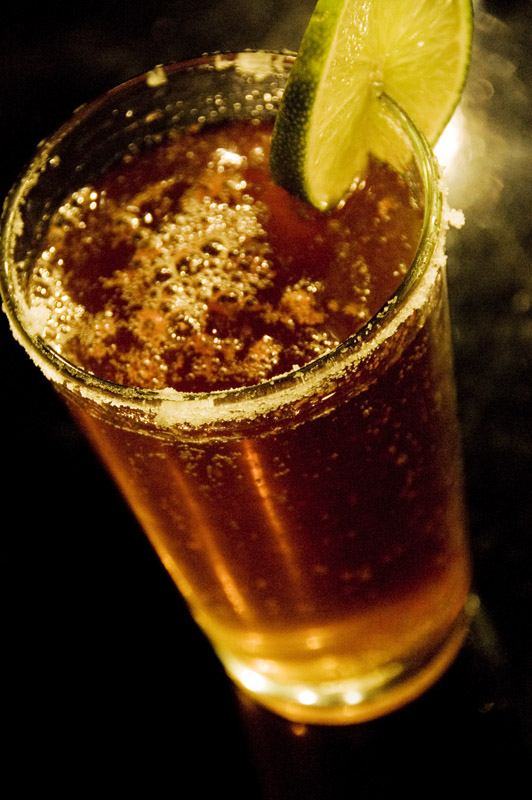
This being a holiday meal, one must have a classy pairing, right? Well, a good Mexican meal calls for a good tequila, and if you insist on ruining it, turning it into a good margarita. (Use lime juice and sugar – please don't buy mixes!) But being who we are, we had to veer a little from the expected terrain of vanilla and make a michelada.

¿Que?

Next time you want a cold drink to go with your chips and homemade guacamole, rim a pint glass with lime and salt, maybe some cayenne pepper if you like a little burn around the lips. Squeeze in the juice of half a lime, a dash or two of hot sauce, and pour in a cheap golden beer. ¡Salud!


15 November 2009

Brown Town Throwdown: Part Deux

Note: This post is back to being only in English because any French person should know how to make crème anglaise or ganache already... Or buy it at Monoprix. :P

Baking several batches of brownies leads to a rather interesting question: What do you do when you've got several kilos of leftover brownies in the house? The first thing, of course, is to unload your chocolate goodness on everyone you know. Then give brownies to them. This week, colleagues, friends, bartenders, neighbors – pretty much anyone in Paris lucky enough to know us – were treated to all three kinds of brownies.

Despite claiming brownie supremacy for our own recipe, nobody seemed to care which one they got. Each sample got ingested quicker than a pile of Colombian "powdered sugar" cookies at a Lohan Mother-Daughter Fundraiser. Real brownies really are that rare in Paris.

However, we still had a good amount of brownie left over, in spite of our sharing spirit. So we took Alannah's classic recipe for bread pudding - and used brownies instead of bread.

Bread pudding is pretty easy. Cut up your bread (or other baked good) into chunks and place in a deep baking dish. Pour a fairly standard custard over it (beaten eggs, milk, cream, sugar, and vanilla - heated moderately so as not to curdle), and place in a medium oven for 45 minutes. Pull it out, let it cool at least a little bit, and voila! Bread Brownie pudding.

This isn't bad on its own, but around this household, we like to push things a bit farther. So it was time for another battle, albeit a little one: How can we best finish off these brownies with a money shot? Is brownie pudding better with the classic crème anglaise? Or Alannah's luxurious dark chocolate ganache?

The ganache-topped brownie was a killer, through and through. A chocolate-sugar rush that would kill that quack Dr. Atkins if his carb-free ass weren't already dead. Something already rich and bold was made richer, bolder, and – we kinda mean it – deadly. The portion pictured above is probably only about 60g. Any more would be like a Mandingo Party in your mouth.

Shifting gears to the one topped with white stuff... Crème anglaise is the French term for runny custard. Which makes this version of the desert rather meta, since the bread brownie pudding is what it is because it's cooked in custard.

If you don't already know how to make a crème anglaise (believe me, one of our friends joked that it's made up from ground up Englishmen, but sometimes I think it's not a joke) and you look it up, you'll see terms like "easy to ruin," "nerve-wracking," or "it's easier just to buy it at the store."

Bullshit.

Beat the ever-loving hell out of two fresh egg yolks with about a cup of sugar and a couple of teaspoons of vanilla extract (or scrape in the grains from one real pod). Bring a cup each of milk and cream to a simmer (not a boil) in a saucepan/pot, remove from heat. Temper your egg mixture with a few spoonfuls of the warm milk/cream. Then pour the mixture back into the pot (again, not on the heat) slowly while whisking. Once integrated, put the pot back over low heat, keep whisking, until everything's simmering again. Pour through a strainer into a bowl to cool. Then, once cool, pour through a strainer again.

On second thought, just go to the store. (Just kidding. Crème anglaise is like meditation. Do it calmly and it's simple and satisfying.)

Beyond the black/white contrast, one thing that makes this version of the brownie pudding great is temperature. Chill the crème anglaise, warm up the brownie pudding. Separately, of course. Then make a small pool of crème in a dish, put a serving of the pudding on top, and drizzle more crème on it.

And that's what makes this one a winner. The contrasting flavors. The differing temperatures. Light versus dark. Cool versus warm.

While Alannah and I both feel that going deep into the dark side of things is great, we're more partial to mixing it up with a little bit of simple vanilla action, to keep things more interesting.

08 November 2009

Brown Town Three-Way


This is our first bilingual post, based upon a little challenge I threw out on Twitter the other day. You see, ever since Alannah and I moved to France, I can count on one hand how many good brownies we've had: None.
Ceci est notre premier billet bilingue, basé sur un petit defi j'ai lancé sur Twitter il y a quelques jours. Depuis que nous avons démenagé à France, je peux compter sur mes doigts exactement combien de bonne brownie on a mangé : Aucun.


When we arrived, a fellow American transplant at work told me at lunch never to order the brownie. "Here?" I asked, referring to the restaurant. "Anywhere in France," he replied. Ouch!


Lorsque nous sommes arrivés, un collegue aussi muté des États-Unis m'a dit pendant le déjeuner de ne jamais commander une brownie. "Ici ?" je lui ai demandé, au sujet du resto. "Non," il m'a dit. "Nulle part en France." Ai !


He was right, though. Nearly two years later, there's not a good brownie to be found. So imagine my excitement when I saw this tweet announcing that a French person was sharing her recipe for real brownies! Not that I needed such a recipe, but I was excited to see that the French have finally figured out how to make brownies.


Mais il a eu raison. Presque deux ans plus tard, je n'ai jamais trouvé de bon brownie. Donc imaginez mon excitation quand j'ai vu ce tweet, disant qu'une française partage sa recette du vraie brownie! Bah oui, je n'ai pas besoin d'une recette, mais j'étais ravi à voir que les français ont enfin appris comment faire la brownie.


I clicked the link and... Dammit! There's baking powder in there! That's a cake! If there's one hard and fast rule about brownies, it's that they don't contain any leavening.


J'ai cliqué le lien et ... Putain ! Il y a de la levure ! C'est un gâteau ! S'il y a un seul règle pour faire la brownie, c'est qu'elles ne contient pas de levure.


I know the French know what they're doing when they bake. They are undeniably the best bakers in the world. This is because they are steeped in tradition and are not keen on bending rules. And that's the problem. The brownie was born of a mistake. Someone forgot to put in the baking powder when making a chocolate cake and voila! There's your brownie.


Je sais que les français savent bien qu'est-ce qu'ils font avec un four. Ils sont sans doute les meilleurs pâtisseurs du monde - c'est incontournable - parce qu'ils sont trempés dans la tradition et ils ne sont pas accoutumés à casser les règles. Et ça c'est le problème. La brownie était née d'une betisse. Quelqu'un a oublié de mettre de la levure dans la pâte d'un gâteau au chocolat, et voila ! La brownie !


@ParisLovesMe said that I, then, should give her a recipe. And I said I'd make some this weekend and even take pictures. The only trouble is... I don't bake, and I rarely use recipes.
@ParisLovesMe m'a dit, donc, que je doit lui donner une recette. Et j'ai dit que je vais faire des brownies ce week-end, et je même prendrais des photos. Le seul problème est ... Je ne fais pas la pâtisserie, et j'utilise rarement les recettes.


So I turned to a couple of my go-to cooks for inspiration: Alton Brown for his scientific, purist approach to American classics, and Thomas Keller for his refined technique. Both offer what I would call an "ultimate" brownie recipe, so I would take the best of both and create my even more ultimate recipe. The figures below are extrapolated for use with an 8.5" round cake pan (because that's what Alannah brought from the US), from Brown and Keller's original recipes for 8" and 9" square cake pans, respectively.
Alors, j'ai cherché l'inspiration de deux cuisiniers : Alton Brown pour sa méthode américaine puriste et scientifique et Thomas Keller pour sa technique raffinée. Les deux proposent ce que j'appelle les recettes "ultimes", et je combinerais toutes les deux dans notre propre recette plus ultime. Les chiffres ci-dessous ont été extrapolés pour utiliser un moule de gateau rond de 8.5"/22cm (car c'est ce qu'Alannah a apporté des USA), contre les recettes originales de Brown et Keller pour les moules carrés de 8"/20cm et 9"/20cm respectivement.


Brown
Keller
Tavallai
eggs/oeufs
215g
125g
170g
sugar/sucre en poudre
190g
260g
150g
brown sugar/
sucre foncé
130g

140g
butter/beurre
200g
240g
220g
cocoa powder/
cacao en poudre

125g
80g
100g
chocolate/chocolate
(60% cacao)

120g
100g
vanilla extract/
extrait de vanille
6.5g
1.5g
4.5g
flour/farine
70g
75g
70g
salt/sel
2.5g
4g
3g
cooking/cuisson
45 min @ 300ºF/
150ºC/th. 5
40-45 min @ 350ºF/
180ºC/th. 6
40 min @ 325ºF/
160ºC/th. 5.5


All three recipes ways require that you beat the hell out of the eggs and fully integrate with the sugar until creamy.

Toutes les trois recettes demandent que vous fouttez les oeufs vigoureusement, et les integrer compètement avec le sucre, jusqu'à il soit crémeux.

Alton Brown's recipe is incredibly simple: Melt the butter and mix in with all of the wet ingredients. Sift together all the dry ingredients, then fold in all of the wet.

La recette d'Alton Brown est incroyablement simple : Fondez le beurre et mélangez-le avec les autres ingrédients humides. Tamisez ensemble les ingrédients secs, puis ajoutez tous les humides.

Thomas Keller's approach calls for melting half the butter, then pouring the melted butter over the solid butter and working it into a mostly consistent, creamy mixture, with lumps of solid butter throughout. The butter mixture is then added - alternating with the sifted dry ingredients - into the egg/sugar/vanilla bowl. Chopped up chocolate chunks are added at the very end.

La méthode de Thomas Keller exige que vous fondez la moitié du beurre, et mélangez-le avec le beurre solide à faire une crème assez consistent, mais avec des petites morceaux de beurre partout. Le mélange est puis ajouté - alterné avec les ingrédients secs - dedans le bol des oeufs/sucre/vanille. Le chocolat - haché en morceaux - est ajouté à la fin.

For the Tavallai version, we went with Keller's more professional technique of folding dry goods and butter into the egg/sugar/vanila mixture. However, I used a whisk to cream the melted and solid butter together - almost whipped - for a smoother butter that marbled into the bowl. Again, the chocolate chunks are added at the end.

Pour la version Tavallai, nous avons suivi la technique plus professionelle de Keller, en mettre les ingrédients secs alterné avec le beurre dans le melange oeuf/sucre/vanille. Cependent, j'ai fouetté le beurre fondu et le beurre solide, comme une crème presque montée, pour un effet marbré dans le bol. Encore, les morceaux du chocolat sont ajoutés à la fin.


As expected with its cocoa-heavy recipe, the Brown version came out very dark, and was difficult to set in the pan because of its concrete-like thickness. The Keller batter was much more fluid, and in every step of the way, much lighter in color. Our version was exactly in the middle.
Comme prévu avec sa recette pleine du cacao, la version Brown était très foncée, et c'était un peu dificile à mettre carrement dans le moule à cause de son épaisseur bétonesque. La pâte lisse Keller était bien plus fluide, et à chaque etape, plus claire en couleur. Notre version restait precisement au milieu.


After cooking, the Brown version was expectedly dark and dense, the Keller version lighter in both color and consistency with a beautiful craquelure, and ours again in between with a mild craquelure but a beautiful two-tone coloring. The chocolate chunks remain solid and visible.
Après la cuisson, la version Brown était foncée et dense comme prevue, la version Keller plus légère et plus claire avec une belle craquelure, et le nôtre encore au milieu avec un effet craquelure bien plus doux, mais avec un effet marbré. Les morceaux de chocolat restent solides et visibles.


I "fileted" each brownie round, and we filed the rest into plastic tubs with labels. This way, we can share each kind of brownie with our friends this week to get their opinions. Don't you wish you were in Paris?
J'ai fait des "filets" avec chaque rond de brownie, et puis nous avoins classé les restes dans des boites en plastique avec des étiquettes. Comme ça, nous pouvons partager chaque genre de brownie avec nos amis cette semaine pour prendre leurs avis. Souhaitez-vous que vous étiez sur Paris ?


For the tasting, we had all three of the brownies presented in each of the ways typical of the respective chef. The Alton Brownies plain, the Thomas Keller brownies dusted with powdered sugar as they are at his Ad Hoc restaurant (and in the Ad Hoc at Home cookbook) and ours with Alannah's trademark dark chocolate ganache, which has already been titillating Parisians with its few public appearances... A total of nine different brownies!
Pour la dégustation nous avons présenté tous les trois recettes à la façon de son chef respectif. Les Alton Brownies nature, les brownies Thomas Keller époussetées du sucre glace comme servie à son resto Ad Hoc (et dans son bouquin Ad Hoc at Home) et le nôtre avec sa fameuse ganache au chocolat noir, qui a déjà titillé plein des parisiens pendant quelques apparitions au public ... un total de neuf brownies différentes !


The Alton Brownies were a dense chocolate bomb. Like having your mouth raped by a giant chocolate wang... Only you can't rape the willing. Delicious, but overwhelming.
Les Alton Brownies étaient une bombe de chocolat. Comme faire violer ta bouche par une grosse bite à chocolat ... Seulement c'est impossile de violer les disposés. Delicieux, mais saissisants.


Keller's brownies are near perfect, as you'd expect from a 3-Michelin starred chef, reminiscent of the amazing chocolate Bouchon from his bakery of the same name. However, Alannah found the powdered sugar to simply get in the way of the chocolate, and we both thought the chocolate chunks were a bit too much. Otherwise, the texture is perfection.
Les brownies de Keller sont presque parfaites, comme prevu pour un chef étoilé (3x), réminiscent de son Bouchon de chocolat de sa boulangerie-pâtisserie éponyme. Cependant Alannah a trouvé le sucre glace interférant du goût de chocolat, et nous avons pensé que les morceaux de chocolat étaient un peux trop. Autrement, la texture est la perfection.


And our version? Let's say this is the first and only time that you will hear of Tavallai trumping Keller. Our recipe truly combines the best of both, delivering the dark chocolate punch of Alton Brown's recipe, and nearly matching the excellent texture of the Thomas Keller recipe. And Alannah's ganache just puts it over the top, though it's a wholly unnecessary luxury. The flavor and level of chocolate are perfect, and a dozen grams of tweaking the butter (more) and brown sugar (less) should yield the velvety texture of the Keller brownies.
Et notre version ? Disons que c'est la première et seule fois que vous entendez que Tavallai a battu Keller. Notre recette combine le meilleur des deux autres recettes, livrant le coup de chocolat de la version Brown, et presque appariant l'excellente texture de la recette Thomas Keller. Et la ganache d'Alannah est vraiement extra, mais c'est un luxe complètement inutile. Le goût et le niveau de chocolat sont parfait, et un dizaine de grams de bidouille du beurre (plus) et sucre foncé (moins) devrait rapporter la texture veloutée des brownies Keller.

13 January 2009

Sticky Sweet: Chocolate Starfish


What do you have for a late night dessert after a homemade Mexican dinner?

Craving churros and hot chocolate - but with no churro stand to be found - we improvised.

Alannah makes a ridiculously thick, sweet, dark hot chocolate that borders on being nearly-solid chocolate sauce. You can eat it with your fingers if you don't mind the risk of getting burned. And the risky behavior is worth it.

We'd made doughnuts a couple of nights earlier, so we warmed up some of the star-shaped ones, rolled them in cinnamon and sugar, and laid them in the hot chocolate upon serving. ¡Muy Sabroso!

12 January 2009

We Did It All for the Gnocchi


There's nothing quite as warming on a winter night as when Alannah works a big, hard piece of meat until it gives out and goes totally soft, left to swim in its juices until sopped up...

We're talking of course, about tough stewing beef - combined with aromatics and wine and cooked for hours and hours in a cast-iron pot. The anticipation for such a dish can be maddening... What's a couple to do while they're waiting seemingly forever for their daube de boeuf to be ready?

Make gnocchi, of course.

As expected for anyone's first time, it was pretty messy... but surprisingly not very painful. A little mashing, a lot of kneading, and about a thousand attempts to roll the "little pillows" off the back of a fork to get it just so.

At the end, a beautiful, chocolate brown daube over tender, handmade gnocchi.

Behind the Scenes
Making a beef daube is easy. Take hunks of the cheapest stewing meat you can find, and sautée it in a Dutch oven or cast iron pot with diced aromatics like onion, carrots and celery. Once they've got a good sheen to them and the meat is browned on the outside, dump in a bottle of dry red wine. You can go cheap here, too, but as a rule, don't go any cheaper than what you'd take to one of your Craigslist casual encounters dates. (i.e. nothing less than $4 or €3 a bottle) The secret: Throw in a square or two of dark chocolate. But no more, unless you want your meat to taste like Chocolate Salty Balls. Then slide the pot into a medium-high oven and let it stew for hours - don't pull out!

Gnocchi - like an Italian woman -is a bit more involved and needs a lot of attention. Boil and mash some potatoes. Prepare a large mixing bowl with some flour and an egg. Add your mashed potatoes and work into a dough. Keep working it until its consistent and has a pasta dough-like consistency. If necessary, sprinkle in more flour as you go along. Once you think you're done (you're probably not!), take balls of the dough and roll them out into long rods, no more than 3/4" or 2cm in diameter. With a sharp knife, slice off little cylinders - about the size of gnocchi. If you ask a guy, they should be about 6" in length. A girl will tell you more accurately that it's less than an inch. Roll the little cylinders along the tines of the back of a fork to get the little ridges that gnocchi - for some reason - is supposed to have. (Told you it's complicated!) Then lay on a dish or tray with lots of flour sprinkled around so they don't stick together, until it's time to give them a very quick boil, just before serving.