Showing posts with label Mexican. Show all posts

05 May 2010

Cinco de Mayonnaise

Believe it or not, this is not another screed against the lack of decent Mexican food in Paris. There's enough about that in past entries. In fact, in light of the fact that it's Cinco de Mayo – wherein Mexico celebrates its ass-whooping of the French during the Battle of Puebla – it's not surprising that the French don't want any real Mexican food to compete with its cuisine. An upstart burrito might actually whomp a crèpe and turn the world of casual gastronomy on its ear, upsetting the order of monotony that keeps Parisians properly dour.

No, sir, I wasn't about to let the un-Mexicanness of anything around us on this most Mexican of marketing-fueled holidays get us down. I laughed off the Cinco de Mayo invites from not-even-Spanish-run Tapas bars flooding my inbox. I resisted the temptation to go to my local bar's tequila night.

Instead, we decided it was time for a little payback: It was time to represent la raza, and turn the tables, fucking with a fundamental of French cuisine. (Never mind that neither of us are Mexican, or Latino for that matter...)

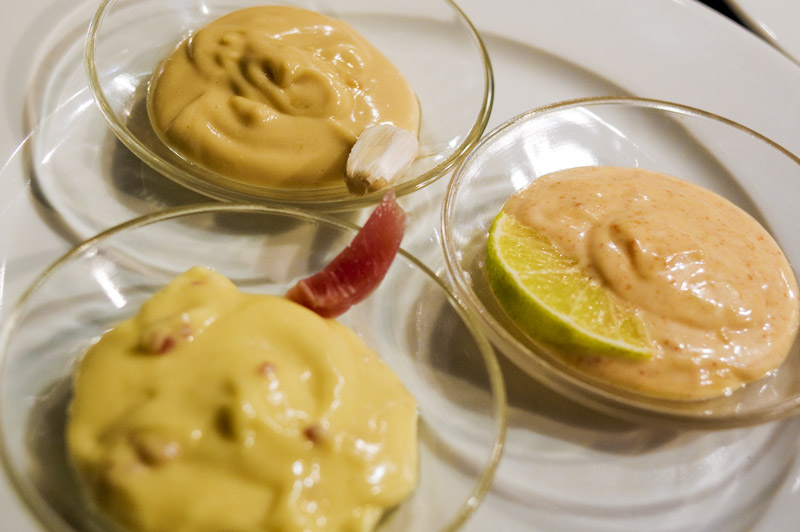
Behold, Cinco de Mayonnaise. Whereupon the standard, classic French recipe for mayonnaise – egg yolk, acid (i.e. vinegar) and oil was bastardized, much the way they louse up Mexican food. I haven't had this much fun vigorously flailing my forearm since I first discovered "making mayonnaise" as an adolescent.
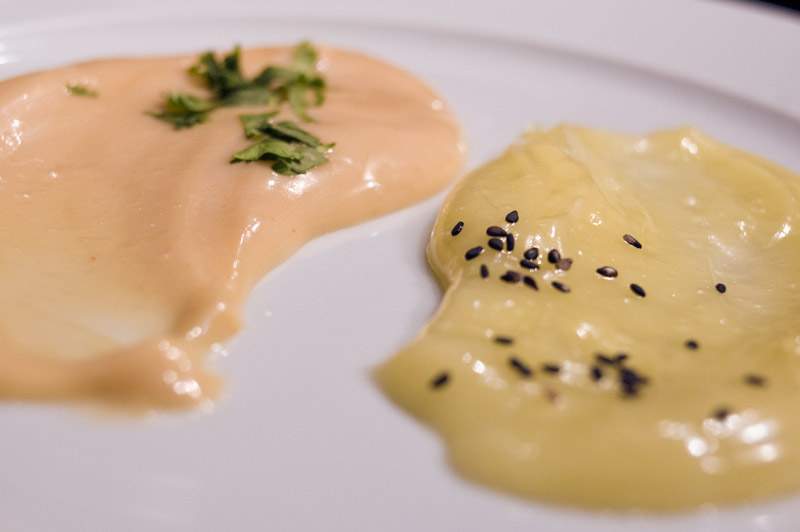
Like yin and yang. Cuz they're Asian. Get it?
First up: Thai mayonnaise (based on Cock-brand fish sauce, sriracha chili, and peanut) and Japanese mayonnaise (based on rice vinegar and sugar for a Kewpie-style taste).

Tres. Cuatro. Cinco.
Rounding out the five: Aioli-styley (based on garlic and balsamic), Mexican (hot chili and lime), and in honor of Jon Stewart, the infamous Baconnaise (based on Dijon mustard and lovingly hand-minced lardon bits).

So to our hermanos y hermanas out there, this messing with French tradition is for you.

Of course, one does not simply tuck into mayonnaise. To quote Vincent Vega in Pulp Fiction, "they drown 'em in that shit." With 'em meaning: French fries.

Best homemade fries ever. (But we can do better!)
After having read about how to make the best Belgian-style double-fried fries over at the French Culinary Institute's "Cooking Issues" blog (highly recommended reading if you're into food science), we decided to give it a go. It's a bit labor-intensive, but the results are way worthwhile. It'll be better once we have a dedicated high-volume deep fryer (soon, my pretties!) but these were awesome.

If you're curious, we skipped the optional pre-blanch step listed in the link above – first off because it's too time-consuming, and secondly because we think Jeffrey Steingarten is an asshat.

Of course, man cannot live on mayo-drenched fries alone. Alannah felt we should have something Mexican and fried up some corn tortillas into tostadas upon which we could have her crazy rich refried beans (featuring lard and lardons), salad, roasted chilis, and sour cream. Sure, it's a bit gringo, but then again, so are we!

"Salad" is only a technical term.
Chugging down a couple of Coronas with lime may have been a bit cheesetacular – especially for purported beer lovers – but hey, what can you do? It was better than going out for freakin' tapas, after all.

29 April 2010

A Sweet, Dark and Spicy Bastard

Despite our despisal of the despicable Tex-Mex places in Paris, we actually do love the bastard cuisine. It's actually one of the oldest American cuisines, the product of years of cultural exchange (or some might say subjugation or domination). We just don't like it when jerkwads try to pass it off as authentic Mexican.

Bastard food has its place, of course.

In fact, this last weekend I got out of bed a bit before Alannah and whipped together some migas, a Tex-Mex bastardization of chilaquiles: Fried stale tortillas scrambled with eggs, topped with chili or salsa, and served with a side of refried beans. (This isn't to be confused with the trendy Spanish version of migas, which is actually not the original, but a derivative of the Texan dish. Whoodathunkit?)

At any rate, this isn't about migas. This is about Alannah's insatiable craving after having snacked on my weekend treat. We had things to do and places to go, but she wanted churros. The trouble is, it was Saturday. And the only good churros we've found in Paris are sold at the Bastille marché on Sundays. (Any and all tips on how to get them on other days are welcome...) There are churro stands here and there, most notably near the crappy crèpe stands around the Grands Boulevards and other places foreigners go drinking, but good churros? Not a chance. The land of churros y chocolate may be just to the southwest, but this is a country resistant to imports.

Yes, churros are of Spanish origin. I always thought they were Mexican, because the guys selling them at amusement parks in California were Mexican. Or Filipino. But that's no way to determine food etymology, is it?

So anyway, Alannah decided to just do it: Make churros.

These churros may look fancy, but they're actually
a complete accident. Like your little brother.

The batter's like a donut batter: Flour, eggs, milk, butter and sugar, only everything's integrated warm on the stove top... She made it and then passed it to me along with a huge pastry bag. So while she went to get all hot & steamy upstairs (in the shower), it was my duty to splash around with hot oil. Ain't marriage grand?

The only problem is that we don't have a huge star tip for the pastry bag. I tried using our biggest tip, squeezing gooey strips of churro batter into the hot oil, only to get what looked like donut-fries. Which I'm sure would do brisk business in middle America, but my gal wanted churros, dammit. Crisp on the outside, chewy-tender on the inside, and hot hot hot! These pathetic little pencil-dicked strips would not satisfy.

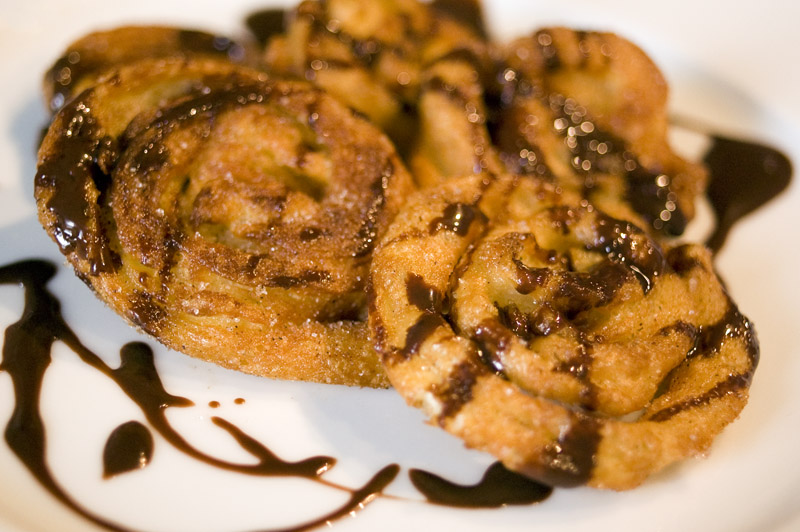
So my Middle Eastern blood kicked in and for the next batch, I squeezed the sac and flipped my wrist in a twirling motion, as though making zoolbia (in Persian, otherwise known as jalebi in Indian/Pakistani cooking). I filled the hot oil with little disks of tightly swirled dough, the end result a golden-brown rose of churro goodness.

By the time Alannah was dressed and back downstairs, I was finishing up a chocolate sauce to drizzle over the hot churros I'd already tossed in cinnamon sugar: Cream, a lot of cacao powder, sugar, cinammon, cayenne pepper, and a few drops of melting chocolate to thicken it.

So I give you, ladies and gentlemen, Chur-rose. Churros shaped like little roses. Hot, sweet, a little bit spicy, and – best of all – a perfectly acceptable bastardization of Latin food that didn't cost an arm and a leg.

20 April 2010

Rant: Mexican't

This is a bitch & moan post with a cause. Read on for the goods.


Last night we ripped on the state of casual American food in Paris, and suggested how easy it is to make far superior burgers and pancakes than what you can find in the slew of "American Diner" themed hovels throughout the town.

Tamales with chicken and chili filling, masa-crusted razor clams,
fresh guacamole... At nuestra casa.
Unfortunately, this situation extends to all sorts of ethnic food in France. Despite being a beautifully multicultural place, what few plausible ethnic restaurants you can find are often "dumbed down" for the local palate. This makes sense in a reputedly risk-averse society, but at the same time makes no sense in the country that coined the term "vive la différence."

Nowhere is this more evident than in the realm of Mexican cuisine, the majority of which is represented by ground beef (!) burritos and insipid fajitas and so-called tacos in factory-made flour tortillas. What the fuck is going on here?  I'll tell you what: The virulent disease known as Tex-Mex, which much like anything from Texas is as irritating and unwanted as a case of syphilis. Only harder to get rid of.  The Tex-Mex trend in Paris has insured that even the most well-meaning of real, Mexican-run restaurants has to sell slushy margaritas and faux burritos to stay in business.

Despite the hardship it presents, the only decent Mexican food in town comes at our own hands. Unlike the aforementioned burgers and pancakes, though, it's not particularly easy. Some of it, like a proper molé sauce, is downright labor-intensive.  But if a guera and a chino gordo (I'm not Chinese, but that's what they call me south of the border) can find the ingredients and take the time to make the real deal, why can't the restaurateurs?

As I write this, I'm eating leftover tamales that Alannah made last night, and even nuked in a plastic tupperware container it's better than anything you can get at the local Indiana Café or Mexi&Co. Yes, the corn husks and masa are hard to source, but they exist.

Admittedly, the razor clams you see above aren't part of the authentic Mexican oeuvre. (Machas, as they're called in Spanish, seem to be limited to Chilean cuisine.) But even the most well-regarded Latin-inspired restaurants here won't dare depart from the established formula and dust some mariscos with masa crocante. They fail to educate or challenge their clientele, and instead bow to their expectations.

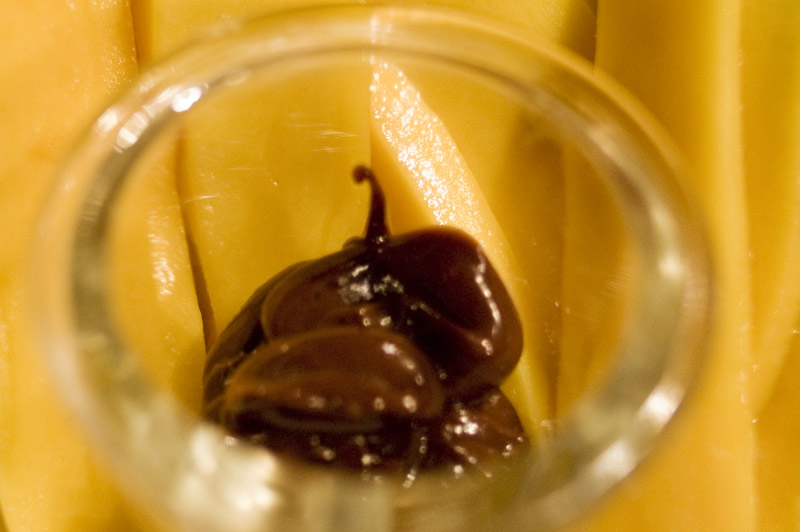
Even the faux Mexican isn't creative. In about three seconds, Alannah whipped up an accompanying dessert for last night's dinner. Sliced fresh mangos with a dipping sauce of chocolate, cream, and spices. While not authentically Latin, it at least played within the flavors of the cuisine, while offering something besides the bastardized mediocrity Parisian diners are accustomed to.

Mango y chocolate... Simple but effective.
The flavors were so fantastic, that we're going to develop a cocktail based on this improvised dessert to serve with Mexican food next time we entertain. Screw your slushy margarita.

The Good Cause Part
Luckily, there is one publicly accessible place where the status quo is being challenged.  At La Rotisserie de Sainte-Marthe in the 10th arrondissement, they have a mission: To prevent the gentrification of their part of the quartier, and to preserve the rich ethnic identity of the many small immigrant groups within.  By day they're a restaurant serving 5-euro meals to the locals. By night, they allow member non-profit organizations to take the restaurant over and share full meals (price cap: 10 euros) with the community.

Once a month, the arts collective Sonidero Tochtli hosts a Mexican dinner. This thursday will feature tacos de barbacoa, nopales (cactus) salad and a convivial community atmosphere unmatched by any other restaurant in town. (The €1.50 beer/wine might have something to do with it.)

It's not fancy. It's elbow-to-elbow seating. But the food is fantastic, and it's all done for good reason. We'll see you there.

30 March 2010

El Bastardo Soup

We could go on and on about the sad state of Mexican (or, really, a lot of ethnic) food in Paris, but despite our crankiness on this subject, we recently had a very uplifting experience. In fact, we had the best Mexican meal at a restaurant anywhere in Europe.

It was at La Rotisserie Sainte-Marthe: A fantastic little hole in the wall in a not-yet-gentrified part of the 10th arrondisement, whose mission, actually, is to keep its little corner from gentrifying. As such, it serves €5 meals to local immigrants and pensioners and broke-asses at lunch time. At night, it transforms into a restaurant associatif – meaning that non-profit organizations can take it over to serve food for fund raisers. Again, to avoid yuppification and to make it accessible to all, there's a €10 price cap.

When we learned that two Franco-Mexican organizations were having a dinner there, it was a no brainer. A tenner for three courses, and beer or wine at laughably low prices. But we'd probably have paid Pierre Gagnaire prices for the food we had. Proper guacamole, a smokey/spicy salsa verde, several carnitas tacos with nopales (cactus), and a humble dessert of strawberries and cream. A simple meal, but one made with real Mexican authenticity never seen in the public sphere on this side of the Atlantic. Take your Michelin-starred restaurants and give 'em a Dirty Sanchez, homes. This shit is soul food for la raza. (Admission: Neither of us is a vato loco.)

We also managed to pick up a huge stack of real corn tortillas, a rare treat. Even rarer not knowing when the next Mexican night at La Rotisserie will be.

Fast forward to tonight. AKA fridge-clearing night. AKA soup night. We've got some quality ground beef left over from Loco Moco, aforementioned corn tortillas, some avocado, a tomato and a half, a carrot... What sort of soup dish could I bash together on this windy, wet night? Tortilla soup is always a winner. And so is albondigas (meatball) soup.  I know, let's bastardize these fine specimens of Mexican tradition.

And thus, El Bastardo was born.

This tortilla soup has three balls
Unlike myself, it's not at all a fucked up combo. In fact, people have probably done it before. I mean, why not?  They go together so well.  And it's so easy.

1) Make some albondigas. Mix ground beef with finely chopped onion, garlic and carrots. Hit it with ground cumin and a bit of salt. Then add a beaten egg, or it won't hold together. You can cook the meatballs separately and add them to the soup just before serving, or you cook them in the soup. We opted for the previous to make sure they held.

2) Make your soup. Since this was a fridge-clearing operation, we diced up some onion, more garlic, whatever tomato we had left, and coined some carrots. They were sautéed in cumin, salt and powdered dry chili, and once adequately softened, about 600ml of beef stock was added to the pot. (You can use any kind of stock, really...)  A bit of tomato paste was added to redden it. Keep that stuff simmering.

3) Slice your corn tortillas into thin strips, pan-fry them in a bit of oil, allow to dry on a cooling rack. If you don't feel like going through the frying step, you don't have to – especially if you've got stale corn tortillas. They're gonna get all soft in the soup anyway. But it really does taste better fried.

Ladle out some soup into a bowl. Lay in a handful of fried (or stale) tortilla strips. Ladle some more soup. Gently cup the balls and gingerly arrange them nicely in the bowl. Garnish with slices of avocado, roughly chopped cilantro (coriander if you swing that way), and a dollop of sour cream (crème fraiche if you swing that way), and you're set.

It's healthy. It's well balanced. And it'll satisfy you on a chilly night like almost nothing else.

Is it authentic? Well, that's relative. If you're anywhere in North America, hell no, esse.

If you're anywhere in Europe (that includes you, España!) it's better than you'll do at any so-called Mexican restaurant. Es una garantiá.


10 January 2010

That Burning Sensation

I was standing naked under a hot stream of water as I cried for Alannah. She ran upstairs as if on cue, a small tub of organic crème fraiche in her hand. I immediately started slathering it on my privates as the hot water showered over my body. It felt so... gooooood.

No, we haven't taken our love for food to a sick new extreme. This is the result of making what I have deemed the Best. Carnitas. Ever.

While at our local outdoor market today, we happened upon a number of fabulous looking ingredients, one of which was gorgeously lean pork shoulder. This became, as we often do when marketing, our key item for the day, around which we'd focus the night's meal: Carnitas. "We still have tortillas," Alannah said. "We can make burritos."

Perfect. We bought a few other ingredients we'd need, including some peppers, onions and (unfortunately out of season) tomatoes to make a salsa. While I usually like my burritos loaded, carnitas are the star when they're the filling, and thus call for a lighter burrito where some nice, crisp veggies are the perfect foil to the rich meat. (For the history and construction of a standard, full-on carne asada burrito in English and in French, see the entry on the proper Mission Burrito.)

Normally, carnitas can be made of just about any meat, but normally pork shoulder. Chunks of it are slowly simmered in lard, and at the end of the process, the temperature is raised until the meat browns. It's then drained, shredded, and – voila – used in a burrito, on a taco, or any of a gazillion other ways Mexican meats are served.


Being in France and always considering local ingredients, I decided to eschew the lard for... duck fat! That's right, folks, we're having carnitas confit for dinner! Here's how it goes:

  • Put about a cup of duck fat in a Dutch oven or cast iron skillet (if you have a cover for the latter)
  • Slather your meat in salt and ground cumin
  • Once the duck fat is clear and simmering, insert your meat, and reduce the temperature to keep the fat at just a simmer. You don't want too much bubbling.
  • Feel free to add some sliced onions, diced chilis, garlic or whatever to the mix. Not necessary, but nice.
  • DO add some slices or wedges of one orange on top.
  • Cover with the lid and allow to simmer 60-90 minutes
  • You'll know the simmering is done when you can break the meat easily with the tip of a spatula.
  • Remove the lid, take out the orange slices, and turn up the heat 'til the fat is bubbling hot. Allow the meat to brown.
  • Once browned, move the meat (and what's left of your onions/peppers/etc.) into a mixing bowl and shred it using two forks. This is easy and kind of fun.
  • If you're a maniac like me, and your fat is still on the heat and reducing, throw the shredded meat back in the fat for an extra dose of richness. If you're sane and don't necessarily want to put your cardiologist's children through private school, skip this step.
Now, enjoy your carnitas.

Tonight, we had it burrito-style with a little rice, pinto beans, sour cream, and salsa. The salsa was made with finely diced sweet onions, the juice of one lemon, a couple of pinches of salt, and three fresh peppers. One red, one green, and one light green.

Now here's the thing. You should always wear protection when dealing with hot peppers. A pair of rubber gloves are indispensable when chopping up and removing the seeds form chilies, preventing that burning-hot capsaicin from getting on your fingertips and under your fingernails.

Of course, we're in France, where the hottest chilies (with the exception of those bought from Asian or African markets) have the strength of half a Maginot line. I've gone to the market and been warned that the peppers I was buying are "très forts" (very strong) only to go home and find that the peanut M&Ms in our candy drawer are spicier.

Well, not tonight.

I prepared the peppers sans-gloves, as I have become accustomed to with the weak-ass peppers of l'hexagone. After mixing and tasting the salsa, I noticed a bit more bite than usual. Well, what a pleasant surprise! The salsa made for an even better accompaniment to the Best. Carnitas. Ever.

It was only after dinner that I noticed my fingers were burning. I attributed it to cooking, my hands dangerously close to the scalding duck fat as I turned the meat while it browned.

Then I went to the bathroom.

And a few minutes later, I felt the burning spread.

Hence why I was just in the shower, rubbing sour cream into my junk as my wife looked on in horror. And maybe amusement.

You'll be happy to know that my wedding tackle is in the clear now. Unfortunately, my hands are still burning, but this means that I've typed out this entry in record time. Because I'm about to run up and soak them in sour cream again.

In the meantime, try and enjoy your carnitas.


12 November 2009

Mission(ary) Position

Carne asada burrito. Guacamole. Salsa. Rice. Black beans... Easy, right?


This is our second bilingual post in a row. After showing all of France how a real brownie is made, we figured it's time to keep schoolin' Parisians on American (or in this case Mexican-American) food. Next lesson: How to make a proper burrito. No offense to those who have set up Mexican restaurants in Paris...
Ceci est notre deuxième billet bilingue. Après avoir montré toute la France comment faire une vraie brownie, nous avons décidé de continuer enseigner les parisiens au sujet de la cuisine américaine (où cette fois mexicaine-américaine). Prochaine leçon : comment faire un vrai burrito. Si vous avez un resto mexicain à Paris, ne le prenez pas mal, mais ...


No, wait a second - be offended. You ass-clowns couldn't fucking make a proper burrito to save your life. Fuck you, your ground beef, and your red beans. Just because your typical customer can't tell Mexican food from a plate full of Tex-Mex vomit doesn't mean you should be serving garbage at €14 a plate. You should be ashamed.
Alors, non ! Prenez-le mal ! Tous vous cons ne peuvent pas faire un vrai burrito pour sauver vos vies. Je vous emmerde. Nique votre viande hachée. Et nique vos haricots rouges. Peut-être votre client typique ne peut pas distinguer entre la nourriture méxicaine et un plat de vomi Tex-Mex, mais ce n'est pas un raison pour servir les déchets à 14 € le plat. Vous devriez avoir honte.


The thing is, making burritos is easy. Why? It originated as a way for Mexican migrant workers in California to take a hot lunch to the field with them. If some poorly paid, overworked, likely undocumented laborer can make a good burrito early in the morning, surely you can do a decent job in your high-rent Parisian kitchen. So listen up. This is coming from a couple of San Franciscans, and everyone knows the best burritos in the world come from San Francisco. Specifically, the Mission District. The poorest, dirtiest parts of the Mission to be exact.
Le truc c'est ... faire le burrito est facile ! Pourquoi ? Il a commencé comme un moyen pour les travailleurs saisoniers mexicains à la Californie d'apporter un déjeuner chaud aux champs. Si un clandestin mal payé et surchargé peut faire un bon burrito le matin, vous pouvez certainement réaliser un burrito acceptable dans votre cuisine Parisienne de luxe. Bon, écoutez bien. Cette demande est d'un couple des san franciscains, et tout le monde sait que le meilleus burrito du monde provient de San Francisco. Spécifiquement du quartier Mission. Les parties plus pauvres et sales de la Mission, exacte.


First, neither one of us don't ever want to see a red bean in a so-called Mexican restaurant again. Or you're going to have two pissed of San Franciscans on your hands. And remember, San Franciscans drink a lot. Which means we fight a lot. So if you don't want a fight on your hands, back away from the red beans. While Mexican cuisine does sometimes make use of small red beans, they're never used in the casual dishes you put on your menus. And certainly not with the big red beans you seem to love so much. If you're serving burritos and tacos, then you use pinto beans or black beans. End of story. Ok, sometimes you can mash the pintos into refried beans, but get your basic beans right before you start experimenting.
Tout d'abord, nous ne voulons jamais revoir un haricot rouge à un resto "mexicain" (bien entre guillemets).  Sinon vous aurez deux san franciscains en pétard. Et rappelez-vous les san franciscains boivent beaucoup. En signifiant nous combattons beaucoup. Alors si vous ne souhaitez pas lutter, ne touchez pas les haricots rouges. Bien sûr on utilise parfois les petits haricots rouges dans la cuisine Mexicaine, ils ne sont jamais utilisés dans les plats typiques de vos cartes. Et certainement pas les gros haricots rouge que vous apparement adorez. Si vous servez les burritos et les tacos, utilisez les haricots roses ou noirs. C'est tout. D'accord, parfois vous pouvez faire purer des haricots pour les "haricots sautés" mais d'abord vous devez apprendre les bons avant de commncer  à expérimenter.


Today, we're doing black beans. They're cheap, they cook relatively quickly, and they're delicious. Simply dump 500g of dry black beans into a large pot of water and bring to a boil. Throw in half a diced onion, one small dried chili, a clove of garlic, and a teaspoon of chili powder. Let it simmer for an hour. Once the beans are tender, you can reduce the heat. Add more water if necessary during the simmering process. Salt to taste, but not too much. You're going to be mixing a lot of flavors.
Aujourd'hui nous faisons les haricots noirs. Ils sont pas chers, ils cuisent relativement vite, et ils sont délicieux. Tout simplement versez 500g des haricots noirs dans un grand casserole d'eau et portez à ébullition. Ajoutez un demi oignon haché, un petit chili seché, une gousse d'ail, et une cuilliere à café de poudre de chili. Mijotez une heure. Lorsque les haricots sont tendres, réduisez bien la chaleur. Vous pouvez ajoutez plus d'eau si vous avez besoin pendant la cuisson. Ajoutez du sel à goût, mais pas trop : vous allez melanger plein des savours !


Next, take any fantasies you have about ground beef and leave them as just that: Fantasies. As in you will never be touching the stuff. Go to the butcher and ask for a nice skirt steak. Today, we're making carne asada. Prepare a marinade of 1 sliced green chili (or jalapeño pepper), a fistful of chopped cilantro (coriander), a teaspoon of chili powder, a generous pinch of salt, a small pinch of black pepper, half a sliced onion, and the juice of one lime and half an orange.  Combine, lay in 300g of tenderized skirt steak (or flank if you want to go cheap). Add half a bottle of beer if you like. And, no, not Desperados you dumbass. That's not even beer, and most certainly not remotely Mexican. Refrigerate for a minimum of 30 minutes.  Bring out of the refrigerator at least 30 minutes before cooking.
Puis, prenez vos imaginations au sujet du boeuf haché et laissez-les en tant que ça : imaginations. Car vous ne le toucherez jamais. Allez voir votre boucher et lui demandez une belle bavette d'aloyau. Aujourd'hui nous faisons du carné asada. Preparez une marinade de 1 piment vert emincé (ou piment jalapeño), une poignée de coriandre hachée, une cc de poudre de chili, une grosse pince du sel, une petit pince de poivre noir, un demi oignion emincé, et le jus de 1 citron vert et demi orange. Combinez, mettez dedans 300g de bavette d'aloyau martelée (ou bavette normale si vous êtes radin). Ajoutez une demi-bouteille de la bière si vous voulez. Et non, pas Desperados, gros con. C'est pas une bière, et certainement pas mexicaine !  Mettez-le dans le frigo au moins 30 minute, et sortez-le au moins 30 minutes avant la cuisson.


In a medium saucepan, heat some olive oil and soften 1/2 of a finely diced onion with chopped up tomato (or a few tablespoons of canned tomato if you swing that way). Once it begins to break down, add a pinch of ground cumin, a large pinch of salt, and half a clove of minced garlic. Then add 150g of rice, which you should sauté until it starts to become clear. Pour in 280ml of water, cover, and bring to a boil. Once boiling, stir, reduce heat to minimum and allow to steam for at least 15 minutes without removing the cover, ever. After 20 minutes tops, you can remove the cover to check it, and then remove it from the heat.
Dans une casserole moyen, rechauffez de l'huile d'olive et ramolissez-vous un demi-oignon finement haché avec un peu de tomate ecrasée (ou quelques ccs de tomate d'une boite si vous préférez. Lorsqu'il commence a décomposer, ajoutez une pince du cumin moulu, une grosse pince du sel, et une demi-gousse d'ail ecrasée. Puis ajoutez 150g du riz, et faites sauter le jusqu'à c'est clair. Versez 280mg d'eau, couvrez la casserole et portez à l'ebullition. Réduisez la chaleur au minimum et laissez comme ça au moins 15 minutes sans jamais toucher le couvercle. Après 20 minutes maximum, vous pouvez enlever le couvercle pour contrôler la cuisson du riz, et enlevez-le du fourneau.


In the meantime, clean and dice 2 large or 3 medium tomatoes, 1 small white onion, and 1/2 of a green chili. Mince 1 clove garlic. Combine in a bowl.
En attendant, nettoyez et découpez 2 grandes ou 3 moyennes tomates, 1 petit oignon blanc et 1/2 d'un piment vert. Ecrasez 1 gousse d'ail. Melangez dans un bol.


In another bowl, use a fork (or two forks) to mash two ripe avocados.  Add 1/3 of the mixture from the previous bowl and the juice of 1/2 lime. Mix well. This is your guacamole.
Dans un autre bol, utilisez une fourchette (ou deux fourchettes) et ecrasez le chair de deux avocats murs. Ajoutez 1/3 du mélange du bol précedent et  le jus d'un demi citron vert. Melangez bien. Ceci c'est votre guacamole.


Go back to your first bowl of tomato/onion/chili/garlic. Give it two generous pinches of salt and mix, allowing to sit at least five minutes. This will leech out the liquid for your salsa. After you see a little of this liquid, go ahead and add the juice of 1/2 lime. This isn't a bad time to throw in a few pinches of chopped cilantro (coriander). This is your salsa.
Retournez au premier bol de tomate/oignon/chili/ail. Mettez dedans deux grosses pinces du sel et melangez, et laissez-le rester au moins cinq minutes. Cette étape coller le liquide pour votre salsa. Après voir un peu de ce liquide, allez-y et ajoutez le jus d'un demi citron vert. C'est aussi un bon moment d'ajoutez quelques pinces de coriandre hachée. Et voila, votre salsa!


Ten minutes before you want to eat, turn on the broiler in your oven, with a rack placed immediately below it. If you don't have a broiler, have a large skillet ready to heat (dry).
Dix minutes avant de manger, allumez le grilleur au votre four avec un plateau mis juste au-dessous. Si vous n'avez pas de grilleur, préparez une grand poêle (sec) à chauffer.


In another skillet, add a tablespoon of oil over high heat and, once hot, gently place your marinated meat and onions. Against all normal instincts, cook the meat until it is medium-well. This step hurts me as much as a good spanking, but trust me, just like then, this is the right thing to do. Once medium-well, remove the steak from the heat and place on a cutting board. Pour the rest of the marinade into the skillet to begin reducing with the now caramelized onions. After the steak has cooled for one or two minutes, begin to slice, then dice. Return to the skillet with the reduced/caramelized onions and mix.  (Some people don't like onions in their carne asada - if that's the case, skip the onions, but do return the meat to the skillet to keep warm.)  Turn off the heat.
Dans une autre poêle sur la chaleur forte, mettez un cs de l'huile, et une fois chaude, mettez la viande marinée et les oignons. Contre tous vos instincts faites cuire bien la viande. Cette étape me blesse autant qu'une bonne fessée, mais me faites confiance, c'est également une bonne chose. Une fois bien cuit (!) enlevez le steak de la chaleur et mettez-le sur un plateau de bois. Versez la reste de la marinade dans la poêle et faites réduire avec les oignons caramelisés. Après laisser le steak refroidir d'un à deux minutes, commencez a le trancher finement, et puis découpez en petits cubes. Mettez-les encore dans la poêle avec la réduction/oignons caramelisés et mélangez. (Certains n'aiment pas des oignons dans le carne asada. Si c'est le cas. n'utilisez pas les oignons, mais re-mettez la viande dans la poêle pour la réchauffer.) Arretez la chaleur.


Now comes the most critical part: your mise en place. Take everything you've made so far and build an assembly line. In order to not get cold, soggy, or break the tortilla wrapper, a burrito must be made quickly and adeptly. Have a cutting board ready with a sheets of foil on it.
Et maintenant la partie la plus critique : votre mise en place. Prenez tous que vous avez faits et créez une chaine de montage. Afin de ne pas refroidir, tremper ou autrement casser la tortilla, un burrito doit être fait rapidement et habilement. Préparez un  plateau de coupe avec des feuilles d'aluminium.


Take 1 flour tortilla and wet it gently on both sides with some water on the palm of your hand. Place it under the broiler of your oven for about 10 seconds each side, or the same on a very hot skillet. This will steam and grill your tortilla at the same time, eliminating the great burrito debate between steamed and grilled.
Prenez 1 tortilla à farine et humidifiez-le légèrement avec un peu de l'eau sur la paume de votre main. Mettez-le sous le grilleur de votre four pour dix secondes chaque côté, ou faites la même chose dans la grande poêle sec. Ceci cuira à la vapeur et grillera votre tortilla en même temps, éliminant la grande discussion du burrito entre la vapeur et la grille.


Fill your tortilla. First, the essentials of a proper Mission-style burrito: Black beans, rice, and meat.  Then come a small dose of your other fillings, including sour cream and grated cheese. Pull a Barack Obama and keep everything right in the unchanging center while skewing slightly to the left. Fold the bottom portion up over the filling, then fold the longer right half over. Then the top flap. You may leave the left end open for presentation.
Remplissez votre tortilla. D'abord avec les éléments essentiels d'un burrito approprié de la Mission : haricots noirs, riz et viande. Puis mettez-vous les autres éléments dont de la crème fraiche epaisse et du fromage râpé. Faites-vous un Barack Obama et restez bien au centre sans rien changer en biasiant légèrement vers la gauche. Pliez la partie inférieure vers le haut au-dessus la farce, puis la partie de la droite. Puis la partie supérieure. Vous pouvez laisser le bout gauche ouvert pour la présentation.


Alternately, you can keep the fillings dead center, and fold the flaps over in a clockwise fashion until you have a nice "pillow". Either way, wrap in the sheet of foil below, then place under the broiler (or in the skillet) to help melt the cheese and maintain the burrito form. This step simulates the car/bike/Muni ride home from the taqueria, and is essential for conditioning your burrito.
Alternativement, vous pouvez mettre tous les éléments en tout milieu et pliez les ailerons de tortilla dans le sense des aiguilles d'un montre jusqu'à vous avez un petit "oreiller". N'import quelle façon, enveloppez-le dans une feuille d'aluminium et mettez-le sous le grilleur (ou dans la poêle) à faire fondre le fromage et gardez la forme du burrito. Cette étape simule le promenade de la taqueria chez vous par voiture/vélo/Muni et elle est essentielle pour conditionner votre burrito.


Serve with some more of the rice and beans if you feel it necessary (though it really isn't) or some plain tortilla chips. If you really want to go vato loco, dress the dish with some radishes and pickled carrot and pepper. 'Cause that's how we do it, esé.
Servez-le avec un peu plus du riz et des haricot si nécessaire (mais c'est vraiment pas) ou des chips tortilla natures. Si vous voudriez vraiment être vato loco, mettez sur le plat des radis roses et des carottes et piments marinés. Car c'est comment on le fait, esé.


Other than the tortilla (notice how we had to use an undersized whole wheat abomination by Old El Paso, as that's all that was available at Monoprix on a holiday evening) all of these ingredients are easy to get just about anywhere. Even Paris. So you have no excuse - none whatsoever - for making a bad burrito. On the off chance that you're a Parisian restaurateur reading this, let us know when you start making burritos this way, and we'll send a ton of business to you.
Autre que la tortilla (remarquez comment on a utilisé une abomination toute petite en blé, faite par Old El Paso car c'était la seule chose disponible chez Monoprix pendant un jour ferié) tous les ingrédients sont facile à trouver n'importe ou. Même Paris. Donc vous n'avez pas d'excuse - pas de tout - pour faire un mauvais burrito. Sur la petite chance que vous êtes un restaurateur parisien qui lit ce billet, signalez-nous quand vous commencez à faire les burritos à cette façon. Nous vous apportons plein de clientèle.

17 May 2009

Warning: Explicit Content

We haven't posted much for a while simply because we haven't been cooking much. This is a bit odd for us, but we have been on vacation, first to Luxembourg where we geeked out on beers and (YES!) street food, then with friends visiting from overseas. A big shout out to Brisbane, Australia and Cal-I-for-ni-yay!

While we'd love to indulge our friends as much as we do for ourselves, it often leads to doing it someplace very uncomfortable, like the back of a Volkswagen. (Which is about how large our Paris flat is.)

Our friend Tanya brought us a bunch of tortillas from California - both white corn and yellow corn. God bless her. Without this little gift from the former Mexican territory, we'd be stuck with eating our own tortillas from scratch. Which aren't half bad, but they aren't half good, either.

As a thank you, I picked up some fresh cod at the local fishmonger while Alannah and Tanya were off doing what two girls do together in Paris (i.e. shopping at Louis Vuitton n' shit), cleaned it up, chopped it... and ruined it by dipping it in beer/masa batter and turning it into fish tacos.


Fancified ones, of course, sitting atop a bed of Spanish rice, fried corn tortillas, shredded white cabbage, and a caraway seed cream sauce.

Success.

The girls went off to Nice for a few days, and I concentrated on work and/or boozing it up with Aussie Tony. Again, a hiatus from the kitchen. We decided, instead, to take a full tour of the watering holes and traditional French restaurants of our neighborhood. When it was time for Tony to head back Down Under, the gals were back, a bit bronzed from the sun (non-existent in rainy Pa-ree this week), but moreover inspired by the southern cuisine they'd just gorged on. So they handed me a bunch of food.

This Is Why We're Amateurs
Apparently, I was out of practice. Way out of practice.

Alannah got me some gorgeous zucchini, knowing how much I like the flowers on them. I'd eaten fiore di zucca before, but it wasn't until we'd traveled to Italy last year that I'd actually developed an intense love for them. Knowing me all so well, this was the perfect gift.

I immediately set out to make fried zucchini flowers for an entrée to impress the ladies. Never mind that I've never bothered to read a recipe.


Instead, we (or rather I) ended up with a fried finger.

The above doesn't look quite as it did the next day, the largest bump blistered to three times the size, nearly transparent, and handled with utter delicacy... A classic second degree burn from hot frying oil.

Needless to say, I've since been taking care of the finger, keeping it away from hot oil, hot water, hot chili - anything that might aggravate the burn... And fueling many of our fantastic local restaurants through la crise economique. Maybe frying a finger isn't so bad after all.

13 January 2009

Sticky Sweet: Chocolate Starfish


What do you have for a late night dessert after a homemade Mexican dinner?

Craving churros and hot chocolate - but with no churro stand to be found - we improvised.

Alannah makes a ridiculously thick, sweet, dark hot chocolate that borders on being nearly-solid chocolate sauce. You can eat it with your fingers if you don't mind the risk of getting burned. And the risky behavior is worth it.

We'd made doughnuts a couple of nights earlier, so we warmed up some of the star-shaped ones, rolled them in cinnamon and sugar, and laid them in the hot chocolate upon serving. ¡Muy Sabroso!

Alannah's Hot Tamales


It's not a sexual proposition but an honest-to-god question uttered by many Californians in Paris: "Whose dick do I have to suck to get some decent Mexican food around here!?"

99.9% of Mexican food in Europe is laughable at best. And for that .1% that isn't, you either have to be the ambassador from Mexico, loaded... or invited into our house. (So that should answer the question above...)

We've tracked down some South American corn masa, but for the proper Mexican stuff, we've stooped to trading favors. And with what little dignity we have, we make our own tortillas and Alannah makes tamales. While a simple concept overall, making a tamal is no simple task. It takes some agile fingers and a deft touch to roll just the amount of masa, cheese, and saucy meat filling into a corn husk - and most importantly, to tie it off with a little strand of more corn husk.

Alannah's good at this. Damn good. Especially since she cooks her carnitas all day in cast iron pot.

After that, it's easy - steam, peel, and eat. Maybe with some crema fresca and fresh avocados or guacamole. Luckily, those are easily available in France. No special favors necessary.